

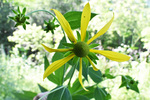
Asteraceae: Rudbeckia laciniata
Files
Family Name
Asteraceae
Common Name
Cutleaf coneflower, Green-headed coneflower
Description
Rudbeckia laciniata is a perennial herbaceous plant growing 1 to 3 meters tall from a thick, fibrous, rhizomatous rootstock. Stems are erect, smooth to slightly hairy, and often branched. Leaves are alternate and deeply pinnatifid or lobed, with basal leaves typically larger, measuring 15 to 40 cm long and 8 to 20 cm wide, with leaf segments lanceolate to linear, pointed, and sharply toothed. Upper stem leaves are smaller, 5 to 15 cm long and 3 to 8 cm wide, with similarly dissected lobes. Leaf surfaces are smooth to slightly hairy, and petioles range from 2 to 10 cm in length. The inflorescence is a large, flat-topped cluster of flower heads blooming from July to September. Each flower head is subtended by an involucre composed of several (usually 8 to 12) overlapping green bracts, which are lanceolate to ovate, 12 to 20 mm long and 3 to 6 mm wide, with smooth to slightly hairy surfaces and often pointed tips. Each head has a central dome-shaped receptacle covered with numerous small disk florets, surrounded by 10 to 20 bright yellow ray florets. Ray florets are strap-shaped, 3 to 6 cm long and 5 to 10 mm wide. Disk florets are tubular, about 5 to 7 mm long. The disk florets have both stamens and pistils; stamens number around 5 per floret with anthers fused into a tube about 2 to 3 mm long. Pistils are single per floret, with styles about 3 to 4 mm long, ending in bifid stigmas. Fruits are dry, one-seeded achenes about 3 to 5 mm long, slightly curved and ribbed, dark brown to black at maturity. In South Dakota, cutleaf coneflower grows in moist woodlands, floodplains, and along stream banks, scattered mostly in the eastern and southeastern parts of the state.
Horticulture Notes
Seed Collection: Collect mature achenes late summer to fall.
Germination: Seeds germinate readily when sown fresh on moist soil.
Vegetative Propagation: Can easily be propagate by division of rhizomes.
Soils: Prefers moist, fertile soils.
Light: Full sun to partial shade.
Water: Prefers moderate to abundant moisture.
Additional Notes
Cutleaf coneflower is valued in native plant gardens and natural landscaping for its tall, striking appearance and long blooming period. It provides nectar for pollinators and seeds for birds. Historically, some Native American tribes used parts of the plant for medicinal purposes.