

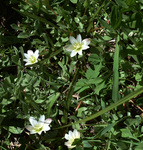
Portulacaceae : Lewisia pygmaea
Files
Family Name
Portulacaceae (Montiaceae)
Common Name
Alpine bitterroot, pygmy bitterroot
Description
Lewisia pygmaea is a small perennial herbaceous plant forming low mats or small rosettes typically 2 to 10 cm tall. It has a fleshy, thickened taproot (caudex). The stems are short and mostly absent or very reduced, often hidden among the leaves. Leaves are basal, simple, fleshy, and linear to spatulate, measuring about 1 to 4 cm long and 2 to 5 mm wide. Leaf margins are entire, and surfaces are smooth and succulent. The inflorescence is a solitary flower or small cluster of flowers on short stalks, flowering from late spring to early summer (May–July). Flowers are star-shaped with 5 to 9 petals, each petal about 5 to 12 mm long and 3 to 6 mm wide, broadly ovate to spatulate, and typically white to pale pink with darker pink or reddish veins. The calyx consists of 5 to 7 sepals that are narrow and lanceolate, about 3 to 6 mm long, often reddish or greenish. The flowers have numerous stamens and a superior ovary. The fruit is a capsule that releases many small seeds. In South Dakota, Alpine bitterroot is native and found in alpine and subalpine rocky outcrops and well-drained mountainous soils in the Black Hills region.
Horticulture Notes
Seed Collection: Collect seeds when capsules dry and open in summer.
Germination: Seeds require stratification and moist, well-drained substrate to germinate. Fall planting is best.
Vegetative Propagation: Can be propagated by division of the caudex.
Soils: Prefers rocky, well-drained, often alkaline soils typical of alpine or dry montane habitats.
Light: Full sun to partial shade.
Water: Requires well-drained soils with moderate moisture; avoid waterlogging.
Additional Notes
Alpine bitterroot is valued for its attractive flowers and ability to thrive in harsh, rocky environments.