

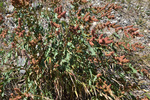
Polygonaceae: Rumex triangulivalvis
Files
Family Name
Polygonaceae
Common Name
Mexican dock
Description
Rumex triangulivalvis is a perennial herbaceous plant growing 40 to 120 cm tall from a thick, creeping rootstock. Stems are erect, smooth to sparsely hairy and often reddish-tinged. Leaves are alternate, broadly ovate to lanceolate, 10 to 30 cm long and 5 to 12 cm wide, with entire to slightly wavy margins and pointed tips. Basal leaves have long petioles, while upper leaves are smaller and may have shorter petioles or be nearly sessile. Leaf surfaces are smooth or sparsely hairy. The inflorescence is a large, loose panicle of many small flowers blooming from June to August. Flowers have greenish to reddish-brown tepals, typically three to six per flower, each 3 to 6 mm long and 1 to 2 mm wide, lanceolate to ovate, with inner tepals often bearing a distinctive triangular shape or tubercle at the tip. Each flower contains six stamens with filaments about 3 to 4 mm long and yellowish anthers approximately 1 to 2 mm long. Pistils number three per flower, each slender and about 4 to 5 mm long, with bifid styles. Fruits are three-sided achenes about 4 to 6 mm long, dark brown to black at maturity, enclosed by the persistent inner perianth. Mexican dock is native to South Dakota and occurs in moist open habitats, disturbed sites, and along waterways, scattered throughout the state.
Synonym: Rumex salicifolius var. mexicanus
Horticulture Notes
Seed Collection: Collect mature seeds in late summer.
Germination: Seeds germinate readily in moist soil conditions.
Vegetative Propagation: Can be spread by root division.
Soils: Prefers moist, well-drained soils.
Light: Full sun to partial shade.
Water: Prefers moderate moisture.
Additional Notes
Mexican dock is a perennial herb found in wetlands and disturbed soils across North America, often used in ecological restoration for erosion control. It offers medicinal benefits as a digestive aid, while its leaves can be eaten, though care is needed regarding oxalates.