

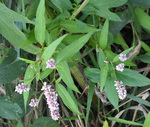
Polygonaceae: Polygonum pensylvanicum
Files
Family Name
Polygonaceae
Common Name
Pennsylvania smartweed
Native American Name
Lakota: táku šašála swúla
Description
Polygonum pensylvanicum is an annual herbaceous plant growing 30 to 100 cm tall from a fibrous root system. The stems are erect, often reddish, and may be branched. The leaves are alternate and petiolate, with petioles 1 to 6 cm long. Blades are lanceolate to ovate-lanceolate, 5 to 12 cm long and 1.5 to 4 cm wide, with entire or slightly wavy margins and a smooth surface, sometimes marked with a dark spot near the middle. The flowers are small, pink to rose, densely arranged in elongated, cylindrical spikes, 2–10 cm long, blooming from July through September. Each flower has five , pink to reddish tepals about 3 to 5 mm long and 1.5 to 2 mm wide and eight stamens with yellow anthers. The pistil has a superior ovary with three slender styles. The fruit is a small, three-angled achene about 2 to 3 mm long and 1.5 to 2 mm wide, maturing from late summer into fall. Pennsylvania smartweed is native to South Dakota and is commonly found in moist to wet habitats such as floodplains, marshes, pond edges, and ditches, especially in the eastern and central regions of the state.
Synonym: Persicaria pensylvanica
Horticulture Notes
Seed Collection: Collect mature achenes in late summer and early fall.
Germination: Seeds germinate readily in moist soil without special treatment.
Vegetative Propagation: Mainly by seed; little vegetative reproduction.
Soils: Prefers moist to wet, often disturbed soils.
Light: Full sun to partial shade.
Water: Requires moderate to high moisture.
Additional Notes
Pennsylvania smartweed provides food and habitat for wildlife, especially waterfowl and various insects. It can be used in wetland restoration and erosion control projects.