

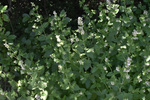
Lamiaceae : Nepeta cataria
Files
Family Name
Lamiaceae
Common Name
Catnip, catmint
Native American Name
Lakota: gmú tȟačhéyaka
Description
Nepeta cataria is a perennial herbaceous plant growing from a fibrous root system, 40 to 100 cm tall with square, branched stems covered in fine hairs. The opposite leaves are ovate to heart-shaped, 3 to 7 cm long and 2 to 5 cm wide, serrated along the margins, and slightly hairy; they release a strong minty aroma when crushed, due to the presence of nepetalactone. The flowers are tubular and bilabiate, arranged in dense, spike-like verticillasters along the upper stems, blooming from late spring through early fall (June–September). Each flower has a calyx composed of five sepals fused into a tubular structure 5 to 7 mm long, with five distinct teeth. The corolla consists of five petals fused into a bilabiate tube 10 to 15 mm long, pale lavender to white with darker purple markings on the lower lip. There are four didynamous stamens (two long and two short), attached near the base of the corolla tube. The pistil consists of a superior ovary with a single style about 4 to 6 mm long, terminating in a bifid stigma approximately 1 to 2 mm wide; the stigma lobes are rounded. The fruit is a schizocarp divided into four smooth, shiny, brown nutlets approximately 2 to 3 mm long. Catnip is an introduced species in South Dakota, commonly found in disturbed sites, roadsides, and open fields throughout much of the state; it is native to Europe and Asia.
Horticulture Notes
Seed Collection: Collect seeds from mature flower heads in late summer.
Germination: Seeds germinate easily in spring without special treatment.
Vegetative Propagation: Easily propagated by cuttings or division.
Soils: Prefers well-drained, fertile soils.
Light: Full sun to partial shade.
Water: Prefers moderate moisture, drought tolerant once established.
Additional Notes
Catnip has a long history of traditional medicinal use as a mild sedative, digestive aid, and remedy for colds, fevers, and headaches. It is commonly brewed as a calming tea. The plant’s essential oils, particularly nepetalactone, have insect-repellent properties, especially against mosquitoes. Ecologically, it attracts pollinators such as bees and butterflies and is famously known for its euphoric effect on domestic cats. It is not recommended for native plantings