

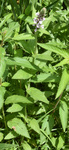
Lamiaceae :Stachys pilosa
Files
Family Name
Lamiaceae
Common Name
Downy woundwort, hairy hedge-nettle
Description
Stachys pilosa is a perennial, herbaceous plant with a fibrous root system and short, creeping rhizomes, forming loose, spreading clumps. Mature plants typically reach 30–90 cm in height. Stems are square in cross-section, erect, usually unbranched below the inflorescence, and densely covered with long, soft, spreading hairs (pilose). Leaves are opposite, simple, ovate to lanceolate, 4–12 cm long and 1–4 cm wide, with coarsely toothed margins and a rounded to slightly cordate base. The upper surface is medium to dark green and softly hairy, while the lower surface is paler and densely hairy. Petioles are present, 1–3 cm long, also covered with hairs. Stipules are absent. Flowering occurs from June to September, with dense, terminal and axillary spikes (verticillasters) 3–10 cm long, each containing many whorls of small, tubular flowers. The calyx is tubular, 7–10 mm long, with five narrow, pointed lobes, green, hairy, and slightly glandular; lobes are equal and not strongly spiny. The corolla is two-lipped (bilabiate), 12–16 mm long, pink to lavender, with the upper lip arched and the lower lip spreading and three-lobed. There are four stamens (didynamous: two longer and two shorter), about 7–10 mm long, with white to pale pink anthers. The pistil is single, with a deeply four-lobed ovary, a slender style 12–15 mm long, and a two-lobed stigma. The fruit is a cluster of four small, brown nutlets, each 2–3 mm long, maturing from late summer into fall. Downy woundwort is native to South Dakota and is found in prairies, open woodlands, roadsides, and moist, disturbed habitats, often in moderately rich, well-drained soils and full to partial sun.
Synonym: Stachys palustris ssp. pilosa
Horticulture Notes
Seed collection: Collect nutlets from mature spikes in late summer to early fall when fruits are dry and easily detach.
Germination: Seeds may benefit from cold, moist stratification (30–60 days); sow on or just below the soil surface in fall or early spring.
Vegetative propagation: Easily propagated by division of rhizomes or basal clumps in spring or fall.
Soils: Prefers moderately rich, well-drained soils; tolerates a range from sandy to loamy.
Light : Thrives in full sun to partial shade.
Water: Prefers moderate moisture; tolerates short dry periods but not prolonged drought or waterlogging.
Additional Notes
Downy woundwort is valued horticulturally for its attractive, hairy foliage and spikes of pink flowers, making it a good choice for native plant gardens, pollinator patches, and restorations. Ecologically, it is important for supporting bees, butterflies, and other pollinators throughout summer, and its dense growth provides cover for small wildlife.