

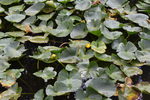
Nymphaeaceae: Nuphar lutea
Files
Family Name
Nymphaeaceae
Common Name
Yellow waterlily, spatterdock
Native American Name
Lakota name: hewápa, khewápa
Description
Nuphar lutea is a perennial aquatic plant with stout, creeping rhizomes anchored in muddy substrates of freshwater ponds, lakes, and slow-moving streams. The floating leaves are orbicular to ovate, 10 to 25 cm long and 8 to 20 cm wide, with a heart-shaped base, thick and leathery with smooth margins and a smooth, glossy upper surface. The solitary flowers, borne on thick stalks rising above the water, have 4 to 6 broadly ovate sepals measuring 15 to 25 mm long, enclosing numerous bright yellow petals about 10 to 15 mm long and 3 to 5 mm wide, which are oblong to spatulate in shape and arranged in multiple layers. The flower contains 40 to 60 stamens with slender filaments and yellow anthers arranged in several concentric whorls around numerous free pistils. Each pistil has a short style and a small, rounded stigma. The fruit is an aggregate of achenes embedded in the spongy receptacle, maturing underwater into a berry-like structure, 3–6 cm in size, containing many small seeds released gradually as the fruits disintegrate. Yellow waterlily, as recognized by the USDA, is native to South Dakota, found in some natural and artificial wetlands, ponds, lakes, and slow-moving waters.
Horticulture Notes
Seed Collection: Collect mature fruits when they soften underwater, usually late summer.
Germination: Seeds may require cold stratification and soaking; propagate in shallow water conditions. Fall planting is recommended.
Vegetative Propagation: Division of rhizomes recommended for best success.
Soils: Thrives in muddy, nutrient-rich substrates underwater.
Light: Full sun to partial shade over water bodies.
Water: Requires shallow freshwater, typically 10–60 cm deep.
Additional Notes
Yellow waterlily provides important habitat and food for fish, amphibians, and aquatic invertebrates. Its broad leaves shade water surfaces, regulating temperature and reducing algae growth. Traditionally, rhizomes have been used medicinally for anti-inflammatory and astringent purposes.