

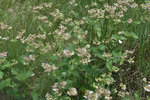
Nyctaginaceae: Mirabilis nyctaginea
Files
Family Name
Nyctaginaceae
Common Name
Wild four o’clock, heartleaf four o’clock
Native American Name
Lakota: poíphiye, caŋȟlóǧaŋ waštémna
Description
Mirabilis nyctaginea is a perennial herbaceous plant typically growing 30 to 90 cm tall. It has a thick, often tuberous root system that helps it survive dry conditions. The stems are erect or sprawling, branched, and covered with fine hairs. Leaves are opposite, ovate to broadly lanceolate, measuring about 4 to 12 cm long and 2 to 6 cm wide, with smooth or slightly wavy margins. The leaf surfaces are smooth to slightly hairy. Leaves are petiolate with slender petioles. The plant is named “four o’clock” because its flowers typically open late afternoon to evening and close by morning. The inflorescence consists of clusters of trumpet-shaped, tubular flowers that are usually cream, yellowish, or pinkish, blooming from summer to early fall (July–September). Each flower is about 2.5 to 4 cm long, with five fused petals forming a funnel shape, the lobes of the corolla are rounded and softly ruffled at the edges. Bracts subtend each flower cluster and are leaf-like, often with pointed tips. They measure 5-6 mm long at anthesis and grow to 1.5 to 3 cm long and 0.5 to 1.5 cm wide in fruit. The flowers are fragrant and attract moths for pollination. The fruit is a small, hard, three-lobed, one-seeded nutlet enclosed in a persistent, winged calyx (bracts). Wild four o’clock is native to South Dakota and commonly found in disturbed areas, roadsides, and open woodlands in much of the state, but is most often reported in central and eastern regions, where agricultural and roadside habitats provide ideal growing conditions.
Horticulture Notes
Seed Collection: Collect mature fruits when dry in late summer.
Germination: Seeds require no special treatment; sow in well-drained soil in spring.
Vegetative Propagation: Possible by division of tuberous roots.
Soils: Prefers well-drained soils but tolerates various soil types.
Light: Full sun to partial shade.
Water: Prefers moderate moisture; tolerates some drought.
Additional Notes
Wild four o’clock attracts pollinators and adds diversity to native habitats. Its flowers open in late afternoon or evening, filling the garden with a sweet fragrance and attracting nocturnal pollinators like moths. This makes it a great choice for “moon gardens” or evening-themed plantings.