

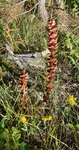
Monotropaceae: Pterospora andromedea
Files
Family Name
Monotropaceae
Common Name
Pinedrops
Description
Pterospora andromedea is a non-photosynthetic, leafless, perennial, parasitic herb growing 20 to 60 cm tall from a thick, fleshy rootstock that forms a mycorrhizal association with certain pine species. The erect stem is reddish to brownish and covered with glandular hairs, branching near the top. Instead of true leaves, it bears scale-like bracts along the stem. The inflorescence is a dense raceme of nodding, urn-shaped flowers blooming from May through August. Each flower measures about 1.5 to 2.5 cm long, with five fused petals, 12 to 18 mm long, forming a pale cream to reddish bell-shaped corolla. The calyx consists of five small, persistent, triangular, greenish to reddish, lanceolate sepals, 3 to 5 mm long, beneath the corolla. Flowers have 10 stamens inserted on the corolla tube, with filaments alternating in length and the anthers are yellow. The style is slender, extending beyond the stamens, terminating in a bilobed stigma. Fruits are capsules, 8–12 mm long, maturing from August through September and contain numerous tiny seeds. Native to South Dakota, Pinedrops is found primarily in coniferous forests, especially under pine trees where its fungal host grows, mainly in the Black Hills and western regions of the state.
Horticulture Notes
Seed Collection: Collect mature capsules when dry in late summer.
Germination: Requires symbiotic fungal partners; difficult to cultivate without mycorrhizal fungi and trees to parasitize.
Vegetative Propagation: Not typically propagated vegetatively.
Soils: Prefers well-drained, acidic forest soils rich in organic matter.
Light: Partial to full shade under forest canopy.
Water: Prefers moist but well-drained soil conditions.
Additional Notes
Pinedrops is primarily of ecological interest due to its parasitic relationship with mycorrhizal fungi and pine roots. It has no significant horticultural use but is valued in native plant and forest ecology studies.