

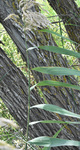
Poaceae: Phragmites australis
Files
Family Name
Poaceae
Common Name
Common reed
Description
Phragmites australis is a tall, perennial grass growing from an extensive, aggressive rhizomatous root system. The rhizomes are thick, woody, and spread horizontally underground, allowing the plant to form dense, often monoculture stands. The roots are fibrous and deeply penetrating, anchoring the plant in wet soils. Stems are erect, hollow, with a smooth texture, and can reach heights of 2 to 4 meters. The leaves are alternate, flat, and linear, 20 to 60 cm long and 2 to 5 cm wide, with rough margins and a pointed tip. The leaf sheaths are smooth, and ligules are short (> 1 mm) and membranous. The inflorescence is a large, feathery, plume-like panicle 15 to 40 cm long, blooming from August through September. Spikelets are small, about 4 to 6 mm long, each containing several florets. Flowers have three stamens with yellow anthers and feathery stigmas. The fruit is a small caryopsis (grain) about 2 to 4 mm long, maturing from September into October. is native to South Dakota or naturalized and occurs in wetlands, marshes, ditches, and along lakes and riverbanks statewide, particularly in lowland and floodplain areas.
Horticulture Notes
Seed Collection: Collect mature seeds in early fall.
Germination: Seeds germinate readily in wet soils; no special treatment needed.
Vegetative Propagation: Spreads aggressively via rhizomes and can easily be propagated by rhizome cuttings.
Soils: Prefers wet, marshy soils, tolerant of flooded conditions.
Light: Full sun.
Water: Requires wet or saturated soils.
Additional Notes
Common reed plays a role in wetland habitat structure and provides nesting sites for birds. However, it can be invasive, outcompeting native plants and altering wetland ecosystems. It is sometimes used for phytoremediation and erosion control. European subspecies A Eurasian phenotype, that has a ligule <1 mm, has been introduced in some locations and is commonly available at plant nurseries.