

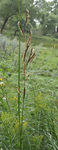
Poaceae: Spartina pectinata
Files
Family Name
Poaceae
Common Name
Prairie cordgrass
Native American Name
Lakota: saŋtúhu iyéčheča
Description
Spartina pectinata is a perennial, warm-season grass with a robust, extensive rhizome system that forms dense, tufted, spreading colonies. Mature plants typically reach 1–2.5 meters in height. Stems are erect, stout, round, and unbranched, often rough to the touch due to tiny hairs. Leaves are alternate, simple, linear, 30–100 cm long and 0.5–2 cm wide, with very rough, scabrous margins and a prominent midvein; the upper surface is green and smooth, while the lower surface is coarser. Leaf bases are sheathed and often overlap, with a short, membranous ligule (1–2 mm) at the junction of blade and sheath. Petioles and stipules are absent, as is typical for grasses. Flowering occurs from July to September, with the inflorescence forming a distinctive, one-sided, comb-like raceme (spicate panicle) 10–30 cm long, composed of 10–40 closely spaced, sessile spikelets arranged alternately along the main axis. Each spikelet is 10–15 mm long, flattened, with two glumes and a single fertile floret. Glumes are lanceolate, 10–15 mm long, greenish to yellowish, rough-edged, and often pointed, one with an awn 1-4 mm long. Each floret has three stamens with long, yellow anthers (2–4 mm) and a pistil with two feathery stigmas; the ovary is single and superior. The fruit is a small, brown, ellipsoid caryopsis (grain), 3–4 mm long, maturing in late summer to early fall and often dropped quickly after ripening. Prairie cordgrass is native to South Dakota and widespread across the state, thriving in wet prairies, sloughs, marsh edges, roadside ditches, and stream banks, especially in moist to wet, periodically flooded soils in full sun.
Horticulture Notes
Seed collection: Collect seeds from mature, golden-brown spikelets in late August to October when grains are firm and heads begin to shatter.
Germination: Seeds benefit from cold, moist stratification (30–60 days); sow shallowly in moist, well-drained soil with light exposure in late winter or early spring for best results.
Vegetative propagation: Readily propagated by division of rhizomes in spring or fall.
Soils: Prefers moist to wet, nutrient-rich soils; tolerates clay, loam, and periodic flooding.
Light: Requires full sun for best growth; does not thrive in deep shade.
Water: Highly tolerant of wet soils and periodic flooding; can survive temporary droughts but prefers consistent moisture.
Additional Notes
Prairie cordgrass is valued horticulturally and ecologically for its ability to stabilize soil in wetland restoration, riparian buffers, and erosion-prone areas. Its dense root system prevents soil loss and filters nutrients, making it a key species in wetland mitigation and water quality projects. It provides good wildlife cover and nesting habitat for birds and small mammals, and its young shoots are grazed by livestock, though mature leaves are tough and less palatable. Prairie cordgrass is occasionally used experimentally in biofuel production due to its high biomass yield.