

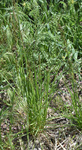
Poaceae: Sporobolus heterolepis
Files
Family Name
Poaceae
Common Name
Prairie dropseed
Description
Sporobolus heterolepis is a perennial, warm-season bunchgrass with a fibrous root system and very short, scaly rhizomes, forming dense, arching clumps. Mature plants typically reach 30–90 cm in height, with flowering stems (culms) rising above the foliage to 60–100 cm. Stems are slender, erect, wiry, and smooth, often with a subtle reddish tinge at the base. Leaves are alternate, simple, narrow, and linear, 20–50 cm long and 1–3 mm wide, tapering to a fine point. Leaf blades are medium to dark green, smooth, and hairless above, with a rougher texture below, and often curl gracefully. The leaf base is sheathed with a short, membranous ligule (1–2 mm). Flowering occurs from August to September, with the inflorescence forming an open, airy, pyramidal panicle 15–30 cm long, bearing many tiny spikelets. Each spikelet is 2–3 mm long, ovoid, with a single floret and two unequal, translucent glumes (1.5–3 mm long). The floret has three stamens with yellow anthers (1–1.5 mm long) and a pistil with two feathery stigmas. The fruit is a small, round, tan to orange-brown caryopsis (grain), 1.5–2 mm in diameter, maturing in early fall and readily dropping to the ground at maturity. Prairie dropseed is native to South Dakota, found throughout the state in prairies, open hillsides, savannas, and roadsides, typically in well-drained, sandy or gravelly soils under full sun.
Horticulture Notes
Seed collection: Collect seeds in late summer to early fall as panicles turn tan and seeds easily drop from the plant.
Germination: Seeds benefit from cold, moist stratification (30–60 days); surface sow in spring or fall for best results.
Vegetative propagation: Best propagated by division of mature clumps in spring.
Soils: Prefers well-drained, sandy, gravelly, or loamy soils; intolerant of heavy or wet soils.
Light: Requires full sun for optimal growth and flowering.
Water: Highly drought-tolerant once established; prefers dry to moderately moist soils but does not tolerate standing water.
Additional Notes
Prairie dropseed is prized for its fine-textured, ornamental foliage and airy flower panicles that add movement and softness to naturalistic landscapes and prairie restorations. It supports prairie ecosystem health by providing habitat for insects and small wildlife and helps stabilize soil with its dense root system. The species is drought tolerant and low maintenance, making it popular in xeriscaping and native plant gardens.