

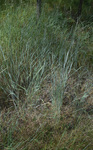
Poaceae: Thinopyrum intermedium
Files
Family Name
Poaceae
Common Name
Intermediate wheatgrass
Description
Thinopyrum intermedium is a perennial, cool-season grass with a fibrous root system and long, stout, creeping rhizomes, forming dense, spreading sods. Mature plants typically reach 90–150 cm in height. Stems are erect, round, smooth, and hollow, with distinct nodes and internodes. Leaves are alternate, simple, linear, 15–30 cm long and 3–10 mm wide, with flat or slightly inrolled blades, scabrous margins, and a prominent midvein; the upper surface is green and smooth or slightly rough, while the lower surface is paler. Leaf sheaths are open and smooth with a prominent, membranous ligule 1–2 mm long at the junction of the blade and sheath; auricles are absent. Flowering occurs from June to July, with inflorescences forming narrow, erect, spike-like racemes (spikes) 8–20 cm long, each with 40–60 closely spaced, sessile spikelets arranged alternately along the central axis. Each spikelet is 12–18 mm long, flattened, and contains 5–10 florets. Glumes are lanceolate, 8–12 mm long, green to straw-colored, and rough-edged. Each fertile floret has three stamens with yellow anthers (2–3 mm long) and a pistil with two feathery stigmas. The fruit is a dry, ellipsoid caryopsis (grain), 6–8 mm long, brownish when mature, and matures from July to August. Intermediate wheatgrass is introduced in South Dakota, native to Europe and western Asia, and is now widely established in prairies, pastures, conservation plantings, roadsides, and disturbed areas, especially in moderately moist, well-drained soils under full sun.
Horticulture Notes
Seed collection: Seeds mature and are harvested from late summer to early fall.
Germination: Seeds germinate best at moderate temperatures in well-drained soil with adequate moisture.
Propagation: By division.
Soils: Prefers well-drained loamy to clay soils; tolerates a wide range of soil conditions including saline and alkaline soils.
Light: Full sun.
Water: Moderate moisture preferred; tolerates drought once established.
Additional Notes
Intermediate wheatgrass is valued for forage, erosion control, and soil stabilization due to its deep root system and adaptability to various soil types. Recently, it has gained attention as the basis for the perennial grain crop marketed as Kernza®, prized for sustainable agriculture. It supports wildlife habitat and contributes to soil health in prairie restorations and pasture management. Although of value to agriculture, this plant is not appropriate for native plantings.