

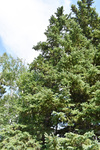
Pinaceae: Picea glauca
Files
Family Name
Pinaceae
Common Name
Black Hills Spruce, White spruce
Native American Name
Lakota: wazíȟčaka
Description
Picea glauca is a tall, evergreen conifer that can reach heights of 20 to 30 meters or more. It has a conical crown with horizontal to slightly drooping branches, a straight trunk with thin, scaly, gray-brown bark. Needles are attached individually and arranged spirally around the twig. They are stiff, sharp, four-sided, 1 to 2.5 cm long, and bluish green to gray green with a whitish waxy coating. Male cones are small, cylindrical, and yellowish, producing pollen released from May to June. Female cones are green when young, maturing to brown in fall, typically 3–7 cm long, with thin, flexible scales. They mature from September through October, with seed dispersal occurring shortly after. The bark, needles, and cones are distinctive to this species. White spruce is native to boreal forests across much of North America, including parts of South Dakota, favoring cooler, moist environments and well-drained soils. Black Hills spruce is a variety of white spruce that is native to a geographically isolated area in and around the Black Hills of South Dakota. It was originally called Picea glauca var. densata, but many experts now designate it as Picea glauca ‘Densata’ because its differences from the species are judged insufficient to justify classification as a botanical variety.
Horticulture Notes
Seed Collection: Collect mature cones in late summer to early fall.
Germination: Seeds require a cold-moist stratification period (3–6+ weeks) to break dormancy, followed by planting in well-drained, moist soil. Germination typically takes 2–4 weeks at room temperature. Seeds should be lightly covered with soil or, ideally, about 1/16-inch of sand for optimal germination rates. Fall planting outdoors is usually successful.
Vegetative Propagation: Possible by grafting or cuttings, but primarily grown from seed.
Soils: Prefers well-drained, acidic to neutral soils.
Light: Full sun to partial shade.
Water: Prefers moist soils but tolerates some drought once established.
Additional Notes
Black Hills spruce thrives in the moist, cool environments of the higher elevations in the Black Hills, typically between 1,200 and 2,000 meters elevation. It prefers well-drained, acidic soils and plays a vital role in forest succession and wildlife habitat. The variety is a key component of the Black Hills forest ecosystem, providing cover for birds and mammals and contributing to soil stabilization. Historically valued by indigenous peoples, including those in the Dakota region, for timber, fuel, and medicinal uses such as teas for respiratory ailments. Its wood is used for construction, paper, and musical instruments.