

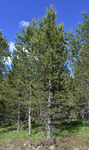
Pinaceae: Pinus contorta
Files
Family Name
Pinaceae
Common Name
Lodgepole pine
Native American Name
Lakota: wazí čháŋ
Description
Pinus contorta is a medium-sized evergreen conifer reaching heights of 15 to 30 meters. It has a narrow, conical crown with dense branches. The bark is thin and scaly on young trees, becoming thick and deeply furrowed with age. Needles occur in pairs (2 per fascicle), are slender and sharp-pointed, 3 to 7 cm long, often twisted and dark green. Male cones are small, cylindrical, 1 to 3 cm long and about 0.5 to 1 cm wide, releasing pollen from May to June. Female cones are oval to conical, 3 to 7 cm long and 2 to 3 cm wide, often serotinous (remaining closed until exposed to fire or heat), they mature over two seasons, changing from a purple green to a light brown color in September or October. Lodgepole pine is native to the Black Hills of South Dakota where it grows in cooler, moist, higher elevation sites, often mixed with ponderosa pine and spruce. It is well adapted to fire ecology.
Horticulture Notes
Seed Collection: Collect mature cones in late summer or fall; cones may require heat to open.
Germination: Seeds germinate best after stratification; sow in the fall in well-drained soil.
Vegetative Propagation: Mainly propagated from seed; cuttings less common.
Soils: Prefers well-drained sandy or rocky soils.
Light: Full sun.
Water: Tolerates dry conditions once established.
Additional Notes
Lodgepole pine wood is used for construction, pulpwood, and fuel. Ecologically, it supports wildlife by providing seeds for birds and mammals and offers shelter in forest habitats and plays a critical role in forest regeneration after disturbance. The common name comes from its use as tipi poles.