

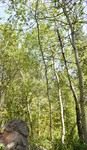
Salicaceae: Populus tremuloides
Files
Family Name
Salicaceae
Common Name
Quaking aspen
Description
Populus tremuloides is a deciduous, fast-growing tree reaching 15 to 25 meters tall with smooth, pale greenish white to gray bark that becomes furrowed with age. The root system is extensive and shallow with vigorous lateral root suckering, allowing the tree to form large clonal colonies. Leaves are alternate, nearly round to broadly ovate, 4 to 8 cm long and 3 to 7 cm wide, with finely serrated margins and flattened petioles that cause the leaves to tremble in the wind. Flowers are produced in catkins; male and female catkins are on separate trees (dioecious). Male catkins are slender and cylindrical, 2 to 6 cm long and about 0.5 to 1 cm wide, releasing pollen from April to May. Female catkins are slightly larger, 3 to 8 cm long and about 0.7 to 1.2 cm wide, maturing from May through June. The fruit consists of small capsules, 5 to 10 mm long, that split open to release numerous tiny seeds attached to cottony hairs which aid in wind dispersal. Native to South Dakota, quaking aspen is widespread in the northern and mountainous regions, commonly found in mixed forests, riparian zones, and upland areas.
Horticulture Notes
Seed Collection: Collect mature seed capsules in late spring when they release seeds.
Germination: Seeds germinate very rapidly, often within 12 to 48 hours, when placed on moist soil in temperatures between 16-32°C (61-90°F). They require no cold stratification but must be sown immediately after collection as they lose viability quickly. Surface sowing on mineral soil is best, ensuring constant moisture.
Vegetative Propagation: Commonly propagated by dividing root suckers in the early spring.
Soils: Prefers well-drained soils but tolerates a range of types.
Light: Full sun.
Water: Prefers moderate moisture but tolerates drought.
Additional Notes
Used traditionally by indigenous peoples for medicine, tools, and ceremonial purposes. The wood is used for pulp, paper, furniture, and light construction. Ecologically, it provides important wildlife habitat and supports forest succession and soil stabilization.