

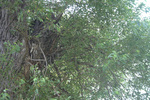
Salicaceae: Salix amygdaloides
Files
Family Name
Salicaceae
Common Name
Peachleaf willow
Native American Name
Lakota name: čhoȟáŋ waŋžíča tȟáŋka, waȟpé pȟópa čháŋ
Description
Salix amygdaloides is a deciduous shrub or small tree growing 6 to 12 meters tall. Young stems have smooth gray bark that becomes furrowed with age. Branches are slender, flexible, and often show a reddish or yellowish tint. Leaves are alternate, simple, narrowly lanceolate to elliptical, 5 to 12 cm long and 1 to 3 cm wide, with finely serrated margins. The upper leaf surface is dark green and mostly smooth, while the underside is paler and can be slightly hairy. Petioles are short, about 5 to 10 mm long. This species is dioecious, meaning male and female flowers grow on separate trees. Flowers emerge in early spring before or alongside leaves, arranged in slender catkins 2 to 6 cm long. Male catkins have multiple stamens, typically 2 per flower, with yellow anthers; female catkins are shorter and thicker, bearing flowers with a single pistil each, with long styles and feathery stigmas. Fruit is a small capsule, maturing in late spring to early summer, releasing tiny seeds surrounded by cotton-like hairs for wind dispersal. Peachleaf willow is native to South Dakota, commonly found along streams, floodplains, and moist bottomlands.
Horticulture Notes
Seed Collection: Late spring to early summer.
Germination: Seeds germinate quickly on moist soil.
Vegetative Propagation: Easily propagated by cuttings.
Soils: Prefers moist to wet soils along watercourses.
Light: Full sun to partial shade.
Water: Requires moist conditions; tolerant of flooding.
Additional Notes
Peachleaf willow is used for erosion control, wildlife habitat, and as browse for deer and other animals. It is also important in riparian restoration.