

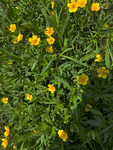
Ranunculaceae: Ranunculus acris
Files
Family Name
Ranunculaceae
Common Name
Meadow buttercup
Description
Ranunculus acris is a perennial herbaceous plant growing 30 to 90 cm tall from a fibrous root system. The stems are erect, branching near the top, and covered with fine hairs. Leaves are alternate, pinnately compound, with deeply lobed leaflets. The basal leaves are long-petioled (2 to 8 cm long) with three to five lobes, while upper leaves are smaller and sessile with narrower lobes. The upper leaf surface is medium green and slightly hairy, while the lower surface is paler with fine hairs. The inflorescence is a loose cluster of bright yellow flowers, about 2–3 cm in diameter, blooming from late spring to mid-summer (May to July). Each flower has five to seven glossy, bright yellow petals about 10 to 20 mm long and 7 to 15 mm wide. The calyx consists of five green, lanceolate sepals about 5 to 7 mm long and spreading backward. Numerous stamens (20–40) and pistils (20-60) are densely packed in the flower center. The style is slender with a rounded stigma at its tip. Fruits are small achenes, 2 to 3 mm long, flattened and slightly curved, often with a short beak at the tip, and clustered in a dense head, maturing from summer to early fall (July-August). Native to Europe and Asia, meadow buttercup has been introduced and naturalized in parts of South Dakota, where they grow in meadows, pastures, and disturbed sites.
Additional Notes
Tall buttercup is mostly considered a weed in pastures and hayfields due to its toxicity to livestock when consumed in large quantities. However, it has ecological value as an early-season nectar source for pollinators.