

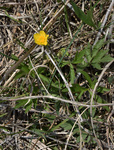
Ranunculaceae: Ranunculus hispidus
Files
Family Name
Ranunculaceae
Common Name
Hispid buttercup, bristly buttercup
Description
Ranunculus hispidus is a perennial herbaceous plant with erect, branched stems growing 20 to 60 cm tall from a fibrous root system. Leaves are alternate and palmately lobed with three to five deeply cut lobes; basal leaves have long petioles 5 to 12 cm long, with leaf blades 4 to 10 cm wide, lobes ovate to lanceolate with pointed tips. Upper leaves are smaller, 2 to 6 cm wide, and may be sessile or have short petioles. The leaf surfaces and stems are densely covered with stiff hairs. Flowers are bright yellow, with five to seven glossy petals that are broadly ovate, 10 to 15 mm long and 7 to 12 mm wide. The calyx consists of five lanceolate sepals, 4 to 6 mm long and 2 to 3 mm wide, often hairy on the back and sides. Each flower contains numerous stamens, typically 20 to 40, with filaments about 2 to 3 mm long and yellow anthers approximately 1.5 to 2 mm long. The flowers also have 20 to 40 pistils, each 2 to 3 mm long, slender and slightly curved, tapering to a pointed tip. Fruits mature from June through July as clusters of small, flattened achenes about 2 to 3 mm long, oblong to slightly curved in shape, and turn from green to light brown or tan when mature. In South Dakota, hispid buttercup is native and is found across a range of habitats including woodlands, open fields, and disturbed sites, preferring moist to well-drained soils throughout the state.
Horticulture Notes
Seed Collection: Collect mature achenes in summer.
Germination: Seeds germinate best when sown fresh on moist soil.
Vegetative Propagation: By division of roots or basal shoots.
Soils: Prefers moist, well-drained soils, often in partial shade.
Light: Partial shade to full sun.
Water: Prefers moderate moisture; not drought tolerant.
Additional Notes
Like many buttercups, Ranunculus hispidus contains compounds that can be toxic if ingested in large amounts, so it's generally avoided by livestock. It provides early-season nectar for pollinators and contributes to biodiversity in native plant communities.