

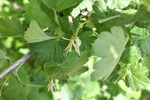
Grossulariaceae: Ribes missouriense
Files
Family Name
Grossulariaceae
Common Name
Missouri gooseberry
Native American Name
Lakota wičhágnaška tȟáŋka
Description
Ribes missouriense is a deciduous, spiny shrub growing 1 to 2 meters tall. The stems are slender, often with arching branches and scattered spines or prickles along its stems. Leaves are alternate, simple, sometimes fascicled on short lateral branches, broadly ovate to orbicular, 3 to 7 cm long and 3 to 6 cm wide, with 3 to 5 lobes, the 2 primary sinuses almost reaching the middle, and coarsely toothed margins. The upper leaf surface is dark green and sparsely hairy, while the lower surface is lighter and more densely hairy. Petioles measure 1 to 3 cm long. The inflorescence consists of nodding, solitary or paired (to 4) flowers that bloom from April through June. The calyx has five triangular sepals, 3 to 5 mm long and about 2 to 3 mm wide, often reflexed. Flowers have five petals that are pale yellow to greenish yellow, rounded to obovate in shape, measuring 6 to 10 mm long and 4 to 7 mm wide. Each flower contains 5 stamens, with filaments about 2 to 3 mm long and yellow anthers approximately 1 to 1.5 mm long, inserted alternate with the petals. The pistil is single with a superior ovary. Fruits mature from July through August as rounded berries about 1 to 1.5 cm in diameter, green when immature, turning dark purple to black when ripe, often covered with a waxy bloom. Missouri Gooseberry is native to South Dakota and grows mainly in wooded ravines, limestone bluffs, and rocky slopes, woodlands, thickets, and along stream banks, primarily in the eastern and southeastern parts of the state.
Horticulture Notes
Seed Collection: Collect mature berries in late summer. Remove seeds from pulp.
Germination: Seeds require a cold-moist stratification period of 90–120 days at 33–38°F to break dormancy, or they can be fall-sown directly outdoors. Seeds should be sown on the surface of moist, humus-rich soil, as they need light to germinate. Germination typically occurs in early spring.
Vegetative Propagation: hardwood cuttings (6-8 inches) taken during the dormant season (Nov-Feb) or softwood cuttings with a heel in summer. (heel - created by pulling a young side shoot downward from a main stem, rather than cutting it, leaving a small piece of "heel" or older bark attached at the base.)
Soils: Prefers well-drained, loamy soils.
Light: Full sun to partial shade.
Water: Prefers moderate moisture.
Additional Notes
Missouri Gooseberry produces edible berries prized for jams, jellies, and fresh eating. The shrub provides cover and food for wildlife and can be used in native plant gardens and restoration projects.