

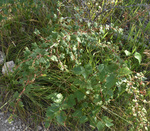
Grossulariaceae: Ribes oxyacanthoides
Files
Family Name
Grossulariaceae
Common Name
Canada gooseberry, Northern prickly gooseberry
Description
Ribes oxyacanthoides is a deciduous, spiny shrub typically growing 0.5–1.5 meters tall with irregularly branched, ascending to sprawling, prickly branches. The stems are slender, yellow to brown when young wing dense prickles on the internodes. The nodes have 1-4 stout brown spines, 5-14 mm long. Older stems become blackened and unarmed. Leaves are alternate, simple, often fascicled at the ends of lateral shoots, broadly ovate to orbicular, usually 3 to 7 cm long and 3 to 6 cm wide, with three major and 2 minor lobes that are sharply toothed or coarsely serrated. The upper leaf surface is dark green and sparsely hairy; the underside is lighter and more densely hairy. Petioles range from 1 to 3 cm long. The inflorescence consists of 1-3(4) nodding flowers blooming from April to June. The calyx has five white to green triangular sepals, forming a hypanthium tube with lobes 3 to 5 mm long and about 2 to 3 mm wide, often reflexed. Flowers have five petals that are pale yellow to greenish yellow, broadly ovate to obovate, measuring 2-3 mm long, erect and shorter than the sepals. Each flower contains 5 stamens with filaments approximately 2 to 3 mm long and yellow anthers about 1 to 1.5 mm long, inserted alternate with the petals. They have a single pistil with a superior ovary and a slender style terminating in a small stigma. Fruits mature from July through August as rounded berries 1 to 1.5 cm in diameter, green when immature, turning red to dark purple at maturity, often covered with a waxy bloom. In South Dakota, northern gooseberry occurs primarily in moist woodlands, forest edges, streambanks, and rocky hillsides, scattered in the western region of the state.
Horticulture Notes
Seed Collection: Collect mature berries in late summer. Remove seeds from pulp.
Germination: Seeds require a cold-moist stratification period of 90 days at 32-41°F to break dormancy, followed by sowing in early spring in moist, humus-rich soil. They germinate best at 1 cm depth, with improved results if seeds are pre-soaked and the soil remains consistently moist.
Vegetative Propagation: Can be propagated by hardwood cuttings taken from November to February or half-ripe, heel-cuttings taken in July/August. Cuttings should be 15–20 cm long, placed in well-drained soil, and kept in a cold frame or sheltered bed.
Soils: Prefers well-drained, loamy soils.
Light: Full sun to partial shade.
Water: Prefers moderate moisture.
Additional Notes
Northern gooseberry produces edible berries that are enjoyed fresh or used in preserves and desserts. It also provides habitat and food for wildlife. The shrub is occasionally used in native plant landscaping and restoration.