

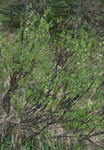
Salicaceae: Salix planifolia
Files
Family Name
Salicaceae
Common Name
Planeleaf willow, diamondleaf willow
Description
Salix planifolia is a deciduous shrub or small tree growing typically 0.5–2 meters tall, often forming dense thickets in alpine and subalpine environments. Branches are slender, flexible, and may be slightly hairy when young, often having a reddish or grayish hue. The bark on young stems is smooth, becoming furrowed with age. Leaves are alternate, simple, and broadly lanceolate to ovate, typically 3 to 8 cm long and 1 to 3 cm wide. Leaf margins are finely serrated or sometimes nearly smooth. The upper leaf surface is dark green and glabrous, while the underside is paler and often covered with fine hairs. Petioles are short, about 3 to 8 mm long. This species is dioecious, with male and female flowers borne on separate plants. Flowers emerge in spring to early summer (April–June), as slender catkins 2 to 6 cm long. Male catkins are slender, typically 2–5 cm long, bearing numerous stamens (usually 2 per flower) with yellow anthers. Female catkins are shorter, bearing flowers each with a single pistil with a long style and feathery stigmas. There are small, leaf-like floral scales (bracts) subtending each flower. The fruit is a small capsule that splits open to release numerous tiny seeds surrounded by cottony hairs. Planeleaf willow is native to South Dakota, growing in mountainous regions of the Black Hills, in moist to wet sites, including stream banks and alpine meadows.
Horticulture Notes
Seed Collection: Late spring to early summer
Germination: Seeds are non-dormant and germinate quickly on moist soil. They need light to germinate, and should be surface-sown on moist, exposed, mineral-rich substrate.
Vegetative Propagation: Easily propagated by cuttings
Soils: Prefers moist to wet soils, in cool or alpine environments
Light: Full sun to partial shade
Water: Moist to wet conditions
Additional Notes
Planeleaf willow provides important habitat and browse for wildlife such as moose, deer, and beaver. It is also important for erosion control and riparian stabilization in its native range.