

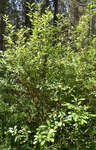
Salicaceae: Salix scouleriana
Files
Family Name
Salicaceae
Common Name
Scouler’s willow, fire willow
Description
Salix scouleriana is a deciduous shrub or small tree growing 3 to 10 meters tall. It has a fast growth habit and often colonizes disturbed or burned areas. The bark on young shoots is smooth and reddish-brown, becoming furrowed and grayish with age. Branches are slender and flexible. Leaves are alternate, simple, and lanceolate to narrowly elliptical, measuring 4–12 cm long and 1 to 4 cm wide. Leaf margins are finely serrated. The upper leaf surface is dark green and glabrous, while the underside is paler and may be slightly hairy. Petioles are about 5 to 12 mm long. This species is dioecious, with male and female flowers born on separate plants Flowering occurs in early spring (April–May), before leaf or with emergence. Flowers are arranged in catkins 3 to 7 cm long. Male catkins are slender, 3–8 cm long, bearing numerous stamens, usually 2 per flower with yellow anthers. Female catkins are shorter and thicker, bearing flowers each with a single pistil an elongated style and feathery stigmas. The flowers have small, leaf-like floral scales (bracts) subtending each flower. The fruit is a small capsule, elliptical to oblong in shape and measuring 4 to 7 mm in length. It splits open to release numerous tiny seeds surrounded by cottony hairs. Scouler’s willow is native to western South Dakota, found in montane to subalpine habitats, especially on recently disturbed soils.
Horticulture Notes
Seed Collection: Late spring to early summer.
Germination: Seeds germinate quickly on moist soil.
Vegetative Propagation: Easily propagated by cuttings.
Soils: Prefers moist, well-drained soils but is adaptable.
Light: Full sun to partial shade.
Water: Moist to wet conditions but can survive some drought.
Additional Notes
Scouler's willow is important for wildlife browse and habitat. It is used in erosion control and riparian restoration projects. It is a pioneer species in ecosystem recovery after fires.