

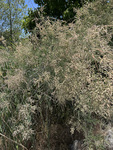
Tamaricaceae: Tamarix ramosissima
Files
Family Name
Tamaricaceae
Common Name
Saltcedar, tamarisk, five-stamen tamarisk
Description
Tamarix ramosissima is a deciduous, perennial shrub or small tree with a deep, extensive root system. Mature plants typically reach 3–6 meters in height. Stems are slender, highly branched, and covered with reddish-brown to gray bark that becomes fissured with age. Leaves are alternate, scale-like, very small (1–3 mm long), narrow, and overlapping, giving the branches a feathery, wispy appearance. Flowering occurs from May to September, with inflorescences forming dense, elongated, spike-like racemes 5–15 cm long, bearing numerous small, five-petaled, pink to pale rose flowers about 4–6 mm in diameter. The calyx is cup-shaped with five fused sepals, 1.5–2 mm long, often glandular-hairy. The corolla has five free petals, 2–4 mm long, ovate to rounded, pale pink to rose-colored. Each flower has five stamens, about 3–4 mm long, with yellow anthers. The pistil consists of a single ovary with a slender style and capitate stigma. The fruit is a small, dry capsule, 1–2 mm long, containing numerous tiny seeds surrounded by tufts of white, silky hairs aiding wind dispersal; fruits mature from July to September. Saltcedar is introduced and invasive in South Dakota, native to Eurasian regions including southeastern Europe, central Asia, and China. It thrives in riparian zones, floodplains, saline soils, and disturbed sites, often outcompeting native vegetation due to its tolerance of drought, salinity, and flooding.
Additional Notes
Saltcedar is an invasive weed. It has been used historically for erosion control and ornamental purposes. Ecologically, it alters soil salinity and water availability, reducing biodiversity and displacing native riparian plants. It provides limited wildlife habitat and food.