

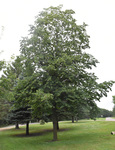
Tiliaceae: Tilia americana
Files
Family Name
Tiliaceae (Malvaceae)
Common Name
American basswood, American linden
Native American Name
Lakota: híŋta
Description
Taxonomic Description:
Tilia americana is a long-lived, deciduous tree with a deep, widespread woody and fibrous root system. Mature trees typically reach 15–30 meters in height, with a straight trunk up to 1 meter in diameter and a broad, rounded crown. The bark is stringy, smooth and gray on branches, developing ridges and furrows on larger branches and the trunk. Twigs are green and slightly hairy when young, becoming smooth, sometimes reddish brown, with age. Leaves are alternate, simple, broadly ovate to heart-shaped (cordate), 10–20 cm long and 7–15 cm wide, with sharply serrated margins, a long tapering tip, and a distinctly asymmetrical base. The upper leaf surface is dark green and glabrous, while the lower surface is paler and finely hairy, especially along veins; leaves have long, slender petioles 5–10 cm long. Stipules are present when young but fall off early in the season. Flowering occurs from June to July, with inflorescences forming drooping, branched cymes (clusters), 5–10 cm long, each attached to a narrow, strap-shaped, pale green bract 5–10 cm long. Each cyme bears 5–15 fragrant, yellowish-white, perfect flowers. The calyx consists of five green, triangular sepals, 4–6 mm long and 2–3 mm wide, free and slightly hairy. The corolla has five, creamy-white, oblong petals, 7–10 mm long and 3–4 mm wide, free and spreading. Each flower has numerous (20–40) stamens with slender filaments and yellow anthers about 1 mm long; the pistil is single, with a five-celled, superior ovary, a slender style, and a capitate stigma. The fruit is a small, globose to ovoid, gray-brown, woody nutlet, 6–10 mm long, often with faint ribs and covered in short, fine hairs; fruits mature from August to October. American basswood is native to eastern South Dakota and is found in rich, moist woods, bottomlands, stream banks, and the eastern deciduous forest edge, typically in deep, fertile, well-drained loams under full sun to partial shade.
Horticulture Notes
Seed collection: Collect nutlets from trees in late summer to fall (August–October) when fruits are dry and easily detach.
Germination: Seeds require cold, moist stratification (90–120 days) for best germination; sow in fall or stratify and sow in spring.
Vegetative propagation: Propagated by softwood or root cuttings; stump sprouting is common in young trees.
Soils: Prefers deep, moist, fertile, well-drained loams; tolerates a range of rich soils.
Light: Thrives in full sun to partial shade.
Water: Prefers consistent moisture; tolerates short dry periods but not extended drought or waterlogged conditions.
Additional Notes
American basswood provides important nectar for bees, making it a favored honey plant. The soft, light wood is prized for carving, furniture, and musical instruments. Native communities historically used the inner bark for cordage and textiles. The tree offers shade, erosion control, and wildlife habitat in forests and urban landscapes. It is also valued in restoration plantings and as a street tree for its attractiveness and shade.