

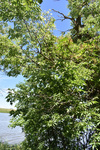
Ulmaceae: Celtis occidentalis
Files
Family Name
Ulmaceae (Cannabaceae)
Common Name
Common hackberry
Description
Celtis occidentalis is a perennial, medium to large deciduous tree. It grows from a deep, spreading root system that is sometimes shallow and wide, allowing for some basal sprouting. Trees can reach heights of 9–20 meters (occasionally taller), with a trunk up to 60 cm or more in diameter. Young bark is thin, gray, and smooth; mature bark is distinctively ridged with warty, corky projections. Branches are spreading and may be somewhat pendulous. Leaves are alternate, simple, ovate to lanceolate, 7–12 cm long and 3–7 cm wide, with an unequal (oblique) leaf base, sharply toothed margins, acuminate tips, and rough upper surfaces; leaves are attached by slender, slightly pubescent petioles. Both young stems and leaves may be slightly hairy, especially below. Flowering occurs from April to May before or with leaf emergence. Flowers are small, greenish and inconspicuous, borne singly (staminate) or in small cymes (bisexual/pistillate) in the leaf axils; individual flowers have 4–5 petal-like sepals. Flowers are mostly monoecious (male and female flowers on the same tree) but can be functionally unisexual. Fruit is a single-seeded, round drupe (hackberry), 6–10 mm in diameter, green turning deep purple or dark red at maturity in late summer to fall. The thin-shelled drupe contains a hard seed and a thin layer of sweet, edible flesh. Common hackberry is native to South Dakota, found in riparian forests, woodland margins, shelterbelts, river bluffs, and occasionally in upland prairies, statewide but especially common in eastern river valleys and shelterbelts.
Horticulture Notes
Seed Collection: Seeds are mature when fruits are fully purple or dark red and begin to fall naturally, typically in late summer to fall.
Germination: Seeds have hard coats and benefit from scarification and 60–90 days of cold stratification; sow outdoors in fall or stratify before spring planting.
Vegetative Propagation: Can be propagated by softwood or root cuttings, but most commonly grown from seed.
Soils: Adaptable to a wide range of soils, from sandy to heavy clay, and tolerates alkaline, rocky, and poor soils. Best in moist, well-drained sites but can survive periodic drought once established.
Light: Prefers full sun but tolerates partial shade.
Water: Prefers moderate moisture; drought-tolerant once mature but benefits from supplemental water when young or in hot, dry periods.
Additional Notes
Common hackberry is native and widely used in horticulture for windbreaks, shade, and wildlife plantings due to its resilience, rapid growth, and adaptability to urban and rural settings. Its fruit is relished by birds and small mammals. Young shoots, bark, and fruit have been traditionally used by Indigenous peoples as food, medicine, and dye—berries can be eaten raw or cooked, but seeds are hard. The wood is used for lumber, furniture, and tool handles. Hackberry is not toxic to humans or livestock.