

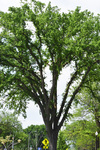
Ulmaceae: Ulmus americana
Files
Family Name
Ulmaceae
Common Name
American elm
Native American Name
Lakota: p’eíkčeka, p’éčhaŋ
Description
Ulmus americana is a large, deciduous tree with a deep, widespread woody and fibrous root system. Mature trees typically reach 20–30 meters in height, with some specimens exceeding 40 meters. The trunk is stout, with grayish-brown bark that becomes deeply furrowed and ridged with age. Branches form a broad, vase-shaped crown with arching limbs. Leaves are alternate, simple, and ovate to elliptical, 7–15 cm long and 5–10 cm wide, with doubly serrated margins and an asymmetrical, uneven base. The upper leaf surface is dark green and rough to the touch with coarse hairs, while the lower surface is lighter green and softly hairy, especially along veins. Petioles are short, 5–15 mm long. Stipules are present, small, and fall early. Flowering occurs in early spring (March to April) before leaf emergence, with wind-pollinated, perfect but apetalous flowers arranged in dense, axillary clusters (cymes) 1–3 cm long. The calyx is inconspicuous; petals are absent. Stamens number 4–5 per flower with elongate filaments and yellow anthers. The pistil has a single ovary with a slender style and two stigmas. The fruit is a flat, round samara, 1–1.5 cm in diameter, with a central seed surrounded by a papery wing, maturing from April to May. American elm is native to South Dakota and occurs primarily in moist bottomlands, floodplains, riverbanks, and rich woodlands, favoring deep, fertile, well-drained soils in full sun to partial shade.
Horticulture Notes
Seed collection: Seeds mature and are collected in late spring (May to June) shortly after flowering.
Germination: Seeds germinate best when sown fresh in moist, well-drained soil with light exposure.
Vegetative propagation: Propagated by grafting, cuttings, and root suckers.
Soils: Prefers moist, well-drained, fertile soils but tolerates a range including clay and silt.
Light: Full sun to partial shade.
Water: Prefers moderate to moist conditions; tolerant of periodic flooding.
Additional Notes
American elm is prized for its stately shape and shade, historically a popular street and park tree. It provides important habitat and nesting sites for birds, and seeds and foliage serve as food for various wildlife. The wood is valued for furniture, veneer, and construction. The species has suffered major declines due to Dutch elm disease but remains significant in restoration and urban forestry where resistant strains are used.