

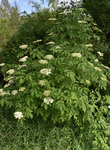
Caprifoliaceae: Sambucus nigra ssp. canadensis
Files
Family Name
Caprifoliaceae
Common Name
American elder, Canadian elderberry
Native American Name
Lakota: čaphute hú
Description
Sambucus nigra ssp. canadensis is a deciduous shrub or small tree growing 2 to 6 meters tall from a stout root system with furrowed grayish bark on older stems. The plant flowers from May through July. Leaves are opposite and pinnately compound with 5 to 9 ovate to lanceolate leaflets, 7 to 15 cm long and 3 to 6 cm wide, serrated margins, dark green and glabrous above, paler and slightly hairy beneath. The inflorescence is a large, aromatic, flat-topped to slightly rounded cyme or panicle 10 to 20 cm wide, with many small creamy-white flowers approximately 5 to 7 mm in diameter. Each flower has five small, greenish, free sepals that are ovate and about 1 to 2 mm long, and five white, rounded, free petals measuring about 4 to 6 mm long. There are typically 20 to 30 stamens per flower with filaments 3 to 4 mm long inserted around the floral receptacle and yellow anthers 1 to 2 mm long. The pistil is forming a compound ovary with 2 to 3 locules, about 2 to 3 mm long, a slender style approximately 1.5 to 2 mm long, and a small, capitate stigma. The fruit is a round, dark purple to black berry about 5 to 8 mm in diameter that ripens from August to September. American elderberry is native to South Dakota, where it occurs primarily in moist woods, thickets, and along stream banks, scattered throughout the eastern and central parts of the state.
Synonym: Sambucus canadensis
Horticulture Notes
Seed Collection: Collect mature berries in late summer to early fall and remove pulp for best germination.
Germination: Seeds require a complex, multi-stage, 5-7 month, cold-moist stratification process to break deep dormancy, often taking 1-2 years to fully germinate. Fall planting and patience will eventually produce results.
Vegetative Propagation: Easily propagated by hardwood cuttings or suckers.
Soils: Prefers moist, fertile, well-drained soils.
Light: Full sun to partial shade.
Water: Prefers moist soils; moderately drought tolerant once established.
Additional Notes
American elderberry is valued for its edible berries, which are used in jams, jellies, wines, and traditional medicine. The flowers are sometimes used for teas and syrups. The plant provides food and habitat for wildlife.