

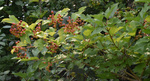
Caprifoliaceae: Viburnum opulus var. americanum
Files
Family Name
Caprifoliaceae (Adoxaceae)
Common Name
American cranberrybush, guelder rose
Description
Viburnum opulus var. americanum is a deciduous, perennial shrub with a fibrous root system. Mature plants typically reach 2–4 meters in height. Stems are erect, woody, and gray brown with smooth bark on young shoots that becomes ridged with age. Leaves are opposite, simple, and broadly ovate to round, 5–15 cm long and wide, with three to five lobes and sharply serrated margins. The upper leaf surface is dark green and glabrous, while the lower surface is lighter green and finely hairy along the veins. Petioles are present, 2–6 cm long. Flowering occurs from May to June, with inflorescences forming large, flat-topped cymes 5–15 cm across, composed of both showy sterile flowers around the edge and numerous small, fertile flowers in the center. Sterile flowers have five white petals, 10–15 mm long and wide; fertile flowers have smaller, 4–6 mm long petals. Stamens number five per fertile flower, with yellow anthers approximately 1 mm long. The pistil consists of a single ovary with a slender style and capitate stigma. The fruit is a bright red, globose drupe, 8–12 mm in diameter, maturing from September to October. American cranberrybush is native to South Dakota and Viburnum opulus var. opulus, the European cranberrybush, that is native to Europe and parts of Asia, is also naturalized in the state. Both occur in moist woods, thickets, wetlands, and along streams, preferring rich, moist, well-drained soils with partial shade. The two varieties are very similar; they can be distinguished by the glands at the tip of the leaf stalk near the blade. Those of the European variety are typically shorter than wide, oval-elliptic, and bowl or cup shaped with a distinct rim. The native variety has glands that are taller than wide, round to oval, flat or rounded at the tip, and lack a distinct rim.
Horticulture Notes
Seed collection: Collect ripe drupes in fall (September–October); remove flesh and clean seeds before sowing.
Germination: Seeds require cold, moist stratification (90–120 days) to break dormancy; sow in fall or stratify and sow in spring.
Vegetative propagation: Propagated by softwood or hardwood cuttings and by layering.
Soils: Prefers moist, rich, well-drained soils; tolerates wet soils and partial shade.
Light: Thrives in partial shade but tolerates full sun.
Water: Prefers consistent moisture; tolerates occasional flooding but not prolonged drought.
Additional Notes
American cranberrybush is valued horticulturally for its attractive, lobed foliage, showy white flowers, and bright red fruit that provide ornamental interest and wildlife food. Ecologically, it supports birds and mammals that feed on the fruit, and its flowers attract a variety of pollinators. The fruit has been traditionally used in jams, jellies, and sauces. Plants found in nurseries tend to be V. opulus var. opulus.