

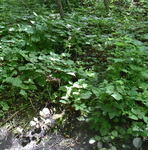
Apiaceae: Sanicula marilandica
Files
Family Name
Apiaceae
Common Name
Maryland black snakeroot, black sanicle
Native American Name
Lakota: waptá yahúžiži, waptá yaȟlá, waptá yaȟóta
Description
Sanicula marilandica is a perennial herb growing 30 to 90 cm tall from a fibrous root system. Flowering occurs from June through September. Leaves are basal and alternate along the stem, palmately compound with 5 to 7 deeply lobed to toothed leaflets, each ovate to lanceolate, 5 to 15 cm long and 3 to 8 cm wide, dark green and glabrous above, lighter beneath. Flowering occurs from late spring to mid-summer (May–August). The inflorescence is a compound umbel, 5 to 15 cm wide, with many small yellow-green flowers about 2 to 3 mm in diameter. Each flower has five small, free, greenish-yellow sepals that are lanceolate to ovate and about 1 to 2 mm long, and five free, yellow, ovate petals about 2 to 3 mm long, often unequal and slightly curved. There are five stamens per flower, opposite the petals, with filaments about 1.5 to 2 mm long attached at the base of the petals, and yellow anthers approximately 0.5 to 1 mm long. The single pistil has an inferior ovary with two fused carpels, 1.5 to 2 mm long, with two locules, a short style about 0.5 mm long, and a bifid stigma. The fruit is a small dry schizocarp about 4 to 6 mm long that ripens in late summer and splits into two one-seeded mericarps. Maryland black snakeroot is native to South Dakota, occurring in rich woods, shaded slopes, shaded ravines, and along stream banks, primarily in the eastern and central parts of the state.
Horticulture Notes
Seed Collection: Collect mature fruits in late summer.
Germination: Seeds require a cold-moist stratification period (around ) ) to break dormancy, typically germinating in 2-3 weeks under ideal, cool, moist conditions. For best results, sow seeds outdoors in autumn or early spring.
Vegetative Propagation: Can be propagated by division.
Soils: Prefers rich, moist, well-drained soils with shade.
Light: Partial to full shade.
Water: Prefers moderate moisture.
Additional Notes
Maryland black snakeroot is valued for its ecological role in woodland habitats, attracting pollinators and providing ground cover. Traditionally used by some Native American groups for medicinal purposes, including treatments for snakebites and other ailments. Its name “snakeroot” comes from its use in folk remedies for snakebite.