

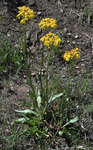
Asteraceae: Senecio integerrimus
Files
Family Name
Asteraceae
Common Name
Wholeleaf ragwort, lambstongue ragwort
Description
Senecio integerrimus is a perennial herb growing 30 to 90 cm tall from a fibrous root system. The stems are erect, mostly smooth with occasional fine hairs, somewhat succulent, and may branch toward the top. Leaves are alternate, simple, lanceolate to narrowly ovate, 5 to 15 cm long and 1 to 5 cm wide, with entire or slightly toothed margins. The upper leaf surface is smooth and dark green, while the lower surface is lighter and glabrous or sparsely hairy. Petioles are short to moderate in length, 1 to 4 cm long. The plant flowers from June through August. The inflorescence is a corymb or loose cluster of 6 to 20, short-stalked, yellow composite flowers about 15 to 25 mm in diameter. Each flower head consists of numerous small florets surrounded by narrow, lanceolate involucral bracts about 5 to 8 mm long and 1 to 1.5 mm wide, free and arranged in several series. Linear-oblong ray flowers (8 to 13) have a strap-shaped petal about 10 to 15 mm long and 3 to 5 mm wide, free and spreading, while disc florets have tubular corollas about 6 to 8 mm long. There are five stamens per floret, with filaments fused into a tube around the style and anthers about 2 to 3 mm long. The pistil is single, about 2 to 3 mm long, a style about 3 to 4 mm long, and a bifid stigma. The fruit is a small achene about 3 to 4 mm long that matures from July to September, topped with a pappus of fine hairs. Lambstongue ragwort is native to South Dakota, found in prairies, open woods, meadows, rocky slopes, and disturbed sites, primarily in the central and western parts of the state.
Horticulture Notes
Seed collection: August and September when achenes mature.
Germination: Seeds need cold stratification. They germinate best in well-drained soil with adequate light and moderate moisture. Best results are achieved by sowing seeds outdoors in late fall
Vegetative Propagation: Propagation generally by seeds; stem cuttings are less common.
Soils: Prefers well-drained, often sandy or rocky soils.
Light: Thrives in full sun.
Water: Drought tolerant once established; requires minimal watering.
Additional Notes
Lambstongue ragwort supports pollinators and contributes to native prairie and open woodland ecosystems.