

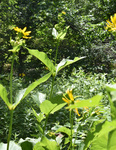
Asteraceae: Silphium perfoliatum
Files
Family Name
Asteraceae
Common Name
Cup plant
Native American Name
Lakota: čhaŋšíŋšiŋla tȟáŋka
Description
Silphium perfoliatum is a robust perennial herb growing 1.5 to 3 meters tall from a deep, long-lived central taproot combined with shallow, aggressive rhizomes that enables the plant to form dense, extensive colonies. The stems are stout, erect, smooth to slightly rough. The plants are notable for the large, opposite, triangular to ovate leaves, 10 to 25 cm long and 8 to 20 cm wide that are fused at the base around the stem, forming a distinctive “cup” which collects water. Leaves have entire margins, the upper leaf surface is rough and dark green, while the lower surface is lighter and may have fine hairs. Petioles are absent. The plant flowers from July through September. The inflorescence is a large, flat-topped cluster of yellow composite flowers about 25 to 40 mm in diameter. Each flower head consists of 10 to 20 ray and numerous disc florets. The involucre consists of several series of overlapping green bracts, lanceolate to ovate in shape, and typically smooth or slightly hairy along the edges. Ray florets are strap-shaped, bright yellow, about 15 to 20 mm long and 3 to 5 mm wide. Disc florets are narrow, tubular, 5 to 7 mm long and also yellow. Stamens number five per floret, with filaments fused into a tube around the style and anthers about 2 to 3 mm long. The pistil consists of two fused carpels forming a compound ovary with two locules, about 3 to 5 mm long, a style about 4 to 6 mm long, and a bifid stigma. The fruit is a small, dry achene about 5 to 7 mm long that matures from September to October and is equipped with a pappus of fine scales aiding in dispersal. Cup plant is native to South Dakota, commonly found in moist prairies, streambanks, and wetland edges in the eastern part of the state.
Horticulture Notes
Seed collection: Seeds are typically collected from September to October when achenes mature and dry.
Germination: Seeds benefit from a cold, moist stratification period of 60–90 days. They need light to germinate and should be sown shallowly in moist, well-drained soil.
Vegetative Propagation: Dividing of mature clumps.
Soils: Prefers moist, fertile soils but can tolerate a range of soil types.
Light: Thrives in full sun to partial shade.
Water: Prefers moist to wet conditions and tolerates occasional flooding.
Additional Notes
Cup plant is valued for its ornamental qualities, pollinator support, wildlife habitat, and erosion control. Its water-holding leaf cups provide habitat for insects and small animals.