

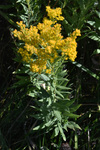
Asteraceae: Solidago altissima
Files
Family Name
Asteraceae
Common Name
Tall goldenrod
Native American Name
Lakota: waȟčáziblu
Description
Solidago altissima is a perennial, herbaceous plant with a fibrous root system and well-developed short rhizomes that form loose colonies. Mature plants typically reach 1–2.5 meters in height. The stems are erect, slender, often branching and reddish or purplish near the base, rough to the touch due to short hairs. Leaves are alternate, simple, somewhat thick and firm, lanceolate to linear-lanceolate, 7–15 cm long and 1–2.5 cm wide, with serrated margins. Leaf surfaces are green, with the upper surface rough and the lower surface softly pubescent; petioles are absent or very short (sessile leaves). Flowering occurs from August to October, with the inflorescence a large, branched, pyramidal panicle up to 40 cm long, composed of hundreds of tiny yellow flower heads. Each head has an involucre with 3-4 whorls of overlapping, lanceolate, green to yellowish bracts, 2–3 mm long, narrowly bell-shaped. Each head has 7–15 yellow ray florets, each 2–4 mm long and 0.5–1 mm wide, and 3–10 yellow disc florets. Stamens are five per disc floret, with yellow anthers about 1.5 mm long, forming a tube around the style. The pistil consists of a single compound ovary per floret, with a style 2–3 mm long ending in a bifid stigma. The fruit is a small, dry, ribbed cypsela (achene), 1–2 mm long, grayish brown, maturing in late fall; each is tipped with a white to pale brown pappus of fine bristles, 2.5 to 3.5 mm long, aiding wind dispersal. Tall goldenrod is native to South Dakota and is found throughout the state, especially in prairies, open woodlands, roadsides, and other disturbed sites with full sun and well-drained soils. This species and Solidago canadensis are very similar. The pappus of altissima is slightly longer and the leaves are thicker and firmer.
Horticulture Notes
Seed collection: Seeds are collected from mature, fluffy seed heads in late fall after the achenes have fully developed and dried.
Seed germination: Seeds require light for germination; best sown on the soil surface and kept moist. No stratification is usually necessary.
Vegetative propagation: Easily propagated by division of rhizomes in spring or fall.
Soils: Prefers well-drained, moderately fertile soils; tolerates a wide range of soil types, including sandy and clay soils.
Light: Thrives in full sun but can tolerate partial shade.
Water: Moderate moisture needs; drought-tolerant once established, but growth is best with regular moisture.
Additional Notes
Tall goldenrod is valued horticulturally for its tall, showy golden flower plumes that attract pollinators such as bees, butterflies, and beneficial insects. Ecologically, it is an important late-season nectar source and provides habitat for a wide range of insects and birds. The species is sometimes used in wildflower gardens, prairie restorations, and erosion control plantings.