

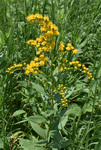
Asteraceae: Solidago gigantea
Files
Family Name
Asteraceae
Common Name
Giant goldenrod
Description
Solidago gigantea is a perennial, herbaceous plant with a fibrous root system and stout, creeping rhizomes that often form loose colonies. Mature plants typically reach 1–2.5 meters in height. The stems are erect, round, and characteristically smooth and hairless (glabrous), often with a reddish or purplish hue, distinguishing them from other goldenrods with rough stems. Leaves are alternate, simple, lanceolate to narrowly lanceolate, 8–20 cm long and 1–4 cm wide, with sharply serrated margins. The upper leaf surface is medium to dark green and smooth, while the lower surface is paler and glabrous or sparsely hairy; leaves are sessile or have very short petioles. Flowering occurs from August to October, with the inflorescence forming a large, open, plume-like panicle up to 40 cm long, composed of numerous small, bright yellow flower heads. Each involucre is bell-shaped, 2–4 mm long, with several overlapping, greenish to yellowish, lanceolate phyllaries. Each flower head contains 7–15 yellow ray florets (2–4 mm long, 0.5–1 mm wide) and 3–10 yellow disc florets. Stamens are five per disc floret, with yellow anthers about 1.5 mm long, forming a tube around the style. The pistil consists of a single compound ovary per floret, with a slender style 2–3 mm long and a bifid (two-parted) stigma. The fruit is a small, dry, ribbed cypsela (achene), 1–2 mm long, grayish brown, maturing in late fall, each topped with a white to pale brown pappus of fine bristles 2 to 2.5 mm long. Giant goldenrod is native to South Dakota and is found widely across the state, especially in moist prairies, stream banks, wet meadows, ditches, and low-lying open areas with full to partial sun and moist to wet soils. Solidago gigantea is one of several large goldenrods that grow in SD. The lack of hairs on the stems (some have a waxy coating) and little or no hairs on the leaf surfaces help to distinguish it from S. altissima and S. canadensis.
Horticulture Notes
Seed collection: Collect seeds from seed heads in late fall after the achenes have matured and dried.
Seed germination: Seeds require light for germination; sow on the surface of moist soil. Stratification is generally not necessary.
Vegetative propagation: Propagated easily by division of rhizomes in spring or fall.
Soils: Prefers moist to wet soils but tolerates a range of soil types, including clay and loam.
Light: Thrives in full sun but tolerates partial shade.
Water: Grows best in moist to wet conditions; tolerates periodic flooding but is intolerant of prolonged drought.
Additional Notes
Giant goldenrod is valued horticulturally for its tall stature and showy golden flower plumes that bloom late in the season, providing a dramatic accent in gardens and naturalized landscapes. Ecologically, it is an important nectar and pollen source for bees, butterflies, and other insects, and its robust growth helps stabilize soils in wet areas. It also provides habitat and seeds for small birds and wildlife. Though generally less aggressive than some goldenrod species, it can spread via rhizomes and may require management to prevent dominance.