

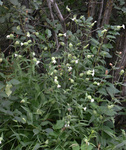
Caryophyllaceae: Silene latifolia
Files
Family Name
Caryophyllaceae
Common Name
White campion, bladder campion
Description
Silene latifolia is a biennial or short-lived perennial herb growing 30 to 90 cm tall from a thick, often woody taproot. There are usually several stems, erect, simple or branched below the inflorescence, and covered with sticky hairs, giving a somewhat rough texture. Leaves are opposite, simple, broadly ovate to lanceolate, 5 to 12 cm long and 2 to 6 cm wide, with entire or slightly toothed margins. The upper leaf surface is dark green and slightly hairy, while the lower surface is paler and also hairy. Petioles are short, typically less than 1 cm long, with the upper leaves often sessile. The inflorescence is a terminal or axillary cluster of white, five-petaled flowers about 20 to 30 mm in diameter. Flowers open in the afternoon into the evening from May through August. The plants are dioecious with male and female flowers are on separate plants. Each flower has five free, green to reddish sepals fused at the base and inflated, about 10 to 15 mm long and 3 to 5 mm wide, covered with sticky hairs. The petals are free, white, obovate, with two deep lobes at the tip, approximately 10 to 15 mm long and 5 to 7 mm wide. Male flowers have 10 stamens, pale yellow, that extend to or a little past the opening of the floral tube, with filaments 5 to 7 mm long and anthers 2 to 3 mm long. Female flowers have a pistil 5 to 6 mm long, with 5 styles that elongate and curl out over the collar. The fruit is a capsule about 8 to 12 mm long that ripens from July to September and opens by 10 teeth to release numerous small seeds. This species is native to Europe but naturalized in South Dakota, where it is found in disturbed sites, roadsides, fields, and open woods, scattered throughout the state.
Additional Notes
White campion is primarily considered a weed but is used ornamentally in gardens. It produces a sweet odor and attracts night-flying pollinators such as moths.