

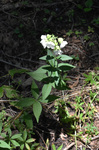
Caryophyllaceae: Silene stellata
Files
Family Name
Caryophyllaceae
Common Name
Starry campion
Description
Silene stellata is a perennial herbaceous plant growing 40 to 120 cm tall from a thickened taproot system. The stems are erect, single or multiple from the base, densely short-hairy in the upper plant and more sparsely so toward the base, and covered with fine, sticky hairs, giving a slightly rough texture. Leaves are simple, opposite in the lower regions and whorled above, ovate to lanceolate, 5 to 12 cm long and 2 to 6 cm wide, with entire margins. The upper leaf surface is dark green and slightly hairy, while the lower surface is lighter and sparsely hairy. Petioles are short, less than 1 cm long, with upper leaves often sessile. The plant bloom from June through September. The inflorescence is a loose cluster of white to pale pink, five-petaled flowers about 20 to 30 mm in diameter. Each flower has five free, green sepals that are tubular and fused at the base, approximately 10 to 15 mm long and 3 to 5 mm wide, covered with fine hairs. The petals are free, white to pale pink, obovate with 8-12 deep lobes at the tip, about 10 to 15 mm long and 5 to 8 mm wide. There are ten white stamens per flower, attached to the inner surface of the floral tube, with filaments 5 to 7 mm long and anthers 2 to 3 mm long. The pistil consists of three fused carpels forming a compound ovary with three locules, about 5 to 6 mm long, a style 4 to 6 mm long, and a three-lobed stigma. The fruit is a capsule, 8 to 12 mm long, that ripens from July to October and opens by six teeth to release numerous small seeds. Starry campion is native to South Dakota, found in rich woods, slopes, and open habitats, primarily in the eastern and central parts of the state.
Horticulture Notes
Seed collection: Typically from September to October when seed capsules dry and open.
Germination: Seeds germinate best in well-drained soil with exposure to light; 60–90 days of cold-moist stratification promotes germination. Fall sowing is preferable.
Vegetative Propagation: Propagated by cuttings is possible.
Soils: Prefers well-drained, rocky, or loamy soils.
Light: Thrives in partial shade to full sun.
Water: Prefers moderate moisture and tolerates some drought once established.
Additional Notes
Starry campion is valued in native plant gardens and natural landscapes for its attractive blooms and ability to attract pollinators such as moths and bees.