

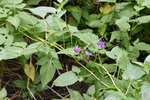
Solanaceae: Solanum dulcamara
Files
Family Name
Solanaceae
Common Name
Bittersweet nightshade
Description
Solanum dulcamara is a perennial, woody, semi-climbing vine or scrambling shrub that can reach lengths up to 3 meters. The stems are slender, flexible, and covered with fine hairs, giving a slightly rough texture. Leaves are alternate and simple, broadly ovate to lanceolate with 2 to 5 deep lobes, measuring 3 to 9 cm long and 2 to 7 cm wide. The upper leaf surface is smooth and dark green, while the lower surface is lighter and may have fine hairs. Petioles are slender and typically 1 to 5 cm long. . The plant flowers from May through September. The inflorescence is a terminal or axillary cluster of star-shaped, purple to violet flowers about 15 to 25 mm in diameter. Each flower has five free, pointed green sepals about 5 to 8 mm long and 2 to 3 mm wide. The petals are fused at the base, forming a shallow star shape with five lobes, each petal is 10 to 15 mm long and 5 to 8 mm wide, with wavy or slightly curled margins. There are five stamens per flower with yellow anthers about 3 to 5 mm long, which release pollen by pores (poricidal dehiscence). The pistil has a single ovary with two fused carpels forming two locules, a style about 5 to 7 mm long, and a small stigma. The fruit is a bright red, oval berry about 10 to 15 mm long that ripens from July to October, containing numerous small seeds. Bittersweet nightshade is native to Europe and Asia but is naturalized and considered invasive in South Dakota, where it grows in wetlands, along streams, roadsides, and disturbed sites.
Additional Notes
Bittersweet nightshade is toxic to humans and animals but has been used historically in traditional medicine with caution. It also provides food for some wildlife species. It is mainly regarded as an invasive species.