

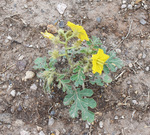
Solanaceae: Solanum rostratum
Files
Family Name
Solanaceae
Common Name
Buffalo bur, spiny nightshade
Native American Name
Lakota: špáŋšni yútapi iyéčheča
Description
Solanum rostratum is an annual, herbaceous plant with a taproot system. It typically grows 30–100 cm tall. The stems are erect or spreading, densely covered with yellow prickles and stellate hairs, giving them a rough texture. Leaves are alternate, simple, and deeply pinnatifid, measuring 5–15 cm long and 3–10 cm wide, with oblong to ovate lobes. Both upper and lower surfaces are green and densely pubescent with star-shaped hairs; petioles are present, 2–8 cm long, and also prickly. Flowering occurs from June to September, with solitary or few-flowered inflorescences (cymes) arising in the leaf axils, each flower about 2–3 cm in diameter. The calyx has five sepals, 8–15 mm long and 3–6 mm wide, lanceolate, green, fused at the base, and armed with prominent yellow spines. The corolla consists of five bright yellow petals, 18–25 mm long and 10–18 mm wide, fused at the base and forming a star shape. There are five stamens, markedly unequal in size; one is much longer than the others, with anthers 6–10 mm long, yellow, and prominently projecting from the flower. This stamen arrangement is a key distinguishing feature, with one larger anther adapted for attracting pollinators and the others for pollen transfer. The pistil is single, with an ovary about 3–4 mm in diameter; the style is slender, 7–10 mm long, and the stigma is slightly capitate and greenish, just above the level of the anthers. The fruit is a globose berry, 1–1.5 cm in diameter, green when immature and turning yellow at maturity, enclosed in a spiny calyx; fruits mature from August to October. Buffalo bur is native to South Dakota, it occurs in disturbed habitats such as roadsides, fields, and overgrazed pastures, establishing readily in sandy or gravelly soils.
Horticulture Notes
Seed collection: Seeds are collected from mature yellow fruits in late summer to early fall; fruits are prickly and may require gloves for handling.
Seed germination: Seeds exhibit some dormancy and may germinate better after scarification or stratification; warm soil temperatures (20–30°C) promote germination.
Vegetative propagation: The species does not propagate vegetatively.
Soils: Prefers well-drained, sandy or gravelly soils; tolerates a wide range of soil types but thrives in disturbed sites.
Light: Requires full sun for optimal growth; does not tolerate deep shade.
Water needs and tolerances: Drought-tolerant once established; prefers dry to moderately moist conditions, but does not tolerate prolonged wet soils.
Additional Notes
Buffalo bur’s spiny nature and toxicity limit its direct use in traditional medicine or food. However, it plays a role in natural ecosystems by providing shelter and habitat for certain insects and small animals. Its flowers attract various pollinators, including native bees and other insects, which benefit from its nectar and pollen. In horticulture, it is not generally cultivated due to its weedy and invasive tendencies, but it can be a valuable species for studying plant-insect interactions and succession dynamics in disturbed habitats.