

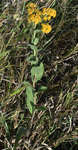
Asteraceae: Solidago rigida
Files
Family Name
Asteraceae
Common Name
Stiff goldenrod
Description
Solidago rigida is a perennial, herbaceous plant with a fibrous root system and short, thick rhizomes or a branched caudex, forming loose clumps rather than dense colonies. Mature plants typically reach 50–120 cm in height. The stems are stout, erect, unbranched below the inflorescence, and covered with coarse, stiff hairs (hispid), giving them a rough texture. Leaves are alternate, simple, and thick-textured (coriaceous), with the largest basal leaves spatulate to oblong, 10–30 cm long and 3–8 cm wide, tapering to a long petiole (up to 10 cm); stem leaves are smaller, 5–15 cm long and 1–3 cm wide, becoming sessile or clasping toward the top of the stem. Leaf margins are entire or slightly wavy; both upper and lower surfaces are gray green, densely covered with short, stiff hairs, and rough to the touch. Flowering occurs from August to October, with the inflorescence forming a dense, flat-topped to slightly rounded corymb or panicle up to 20 cm across, with numerous bright yellow flower heads. Each involucre is hemispheric to bell-shaped, 5-9 mm tall, with overlapping, green, broadly lanceolate to ovate phyllaries, often with stiff hairs. Each head contains 8–20 yellow ray florets (5–8 mm long, 1–2 mm wide) and 15–31 yellow disc florets. Stamens are five per disc floret, with yellow anthers about 2 mm long, forming a tube around the style. The pistil consists of a single compound ovary per floret, with a slender style about 3 mm long and a bifid stigma. The fruit is a small, ribbed cypsela (achene), 2–3 mm long, prominently ribbed, brown when mature in late fall, each topped with a single row of stiff, yellowish pappus bristles. Stiff goldenrod is native to South Dakota and is found throughout the state in prairies, open woodlands, rocky hillsides, and occasionally roadsides, preferring dry to moderately moist, well-drained soils in full sun.
Horticulture Notes
Seed collection: Collect seeds from mature, dry seed heads in late fall after achenes have fully developed.
Germination: Seeds require light for germination; sow on the soil surface. Cold stratification (30–60 days) may improve germination rates.
Vegetative propagation: Propagated by division of basal clumps or rhizomes in spring or fall.
Soils: Prefers well-drained, sandy, loamy, or rocky soils; tolerates moderately moist to dry conditions.
Light: Requires full sun for optimal growth and flowering.
Water: Moderately drought tolerant; grows best with occasional moisture but does not thrive in wet soils.
Additional Notes
Stiff goldenrod is important ecologically, supporting a wide range of pollinators, including bees, butterflies, and other beneficial insects during late summer and fall. It provides seeds and habitat for small birds and insects. In horticulture, it’s appreciated for prairie restoration, naturalized landscapes, and erosion control due to its drought tolerance and sturdy growth. Because of its stiff leaves and upright habit, it adds structural interest to plantings. It can spread by rhizomes but is generally well-behaved in managed garden settings.