

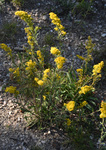
Asteraceae: Solidago simplex
Files
Family Name
Asteraceae
Common Name
Sticky goldenrod
Description
Solidago simplex is a perennial, herbaceous plant with a fibrous root system and short, slender rhizomes, forming loose tufts or small colonies. Mature plants typically reach 20–70 cm in height. Stems are erect, slender, often reddish at the base, and usually glabrous or with sparse, fine hairs; in some subspecies, the upper stem may be glandular-sticky. Leaves are alternate, simple, and mostly linear to narrowly lanceolate; basal leaves are the largest, 8–20 cm long and 0.5–2 cm wide, with a prominent midvein and entire or slightly toothed margins. Basal leaves taper to a short petiole (1–3 cm), while upper leaves are much smaller (2–8 cm long, 2–7 mm wide), progressively reduced and sessile toward the inflorescence. Leaf surfaces are green, with the upper surface smooth and the lower surface sometimes sparsely hairy or glandular. Stipules are absent. Flowering occurs from July to September, with the inflorescence forming a narrow, erect or one-sided raceme or panicle up to 15 cm long, with numerous small, bright yellow flower heads. Each involucre is narrowly bell-shaped, 2–3 mm long, with several overlapping, green to yellowish, lanceolate phyllaries, sometimes glandular. Each head contains 6–12 yellow ray florets (2–3 mm long, 0.5–1 mm wide) and 3–8 yellow disc florets. Stamens are five per disc floret, with yellow anthers about 1–1.5 mm long, forming a tube around the style. The pistil consists of a single compound ovary per floret, with a slender style about 2 mm long and a bifid stigma. The fruit is a small, ribbed cypsela (achene), 1–2 mm long, brown when mature in late summer to early fall, each topped with a single row of white to pale brown pappus bristles. Sticky goldenrod is native to South Dakota and is found in mountainous areas in the western part of the state, in prairies, roadsides, rocky outcrops, sand dunes, and dry, open habitats with well-drained soils in full sun.
Horticulture Notes
Seed collection: Collect seeds from fluffy seed heads in late summer to early fall when achenes are dry and mature.
Germination: Seeds require light for germination; sow on the soil surface. Cold stratification can improve germination rates. Vegetative propagation: Propagated by division of basal clumps or short rhizomes in spring or fall.
Soils: Prefers well-drained, sandy, gravelly, or rocky soils; tolerates nutrient-poor, dry soils.
Light: Requires full sun for optimal flowering and growth.
Water: Highly drought tolerant; grows best in dry to moderately moist conditions but does not tolerate prolonged wet soils.
Additional Notes
Sticky goldenrod supports pollinator populations by providing nectar and pollen during mid to late summer. It also offers food and cover for small wildlife. In horticulture, it is valued for naturalized plantings and ecological restorations, especially in well-drained, rocky, or mountainous sites where drought tolerance is beneficial. It contributes to soil stabilization and adds vertical texture in native garden designs. The species is generally not aggressive and blends well in mixed perennial plantings.