

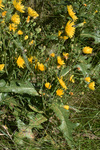
Asteraceae: Sonchus arvensis
Files
Family Name
Asteraceae
Common Name
Field sow-thistle, perennial sow-thistle
Description
Sonchus arvensis is a perennial, herbaceous plant with a deep, extensive creeping root system and stout rhizomes, often forming dense colonies. Mature plants typically reach 60–150 cm in height. The stems are erect, hollow, branched above, and glabrous or sparsely hairy, often exuding a milky sap when cut. Leaves are alternate, simple, oblong to lanceolate, 10–35 cm long and 2–8 cm wide, deeply pinnately lobed with prickly, undulate margins; basal leaves are larger and taper to a winged petiole, while upper leaves are smaller, more clasping, and often auriculate (with ear-like lobes at the base). Both surfaces are green, with the upper surface smooth and the lower surface sometimes sparsely hairy along the veins. Petioles are present on basal leaves; upper leaves are sessile and clasp the stem. Stipules are absent. Flowering occurs from July to September, with the inflorescence forming a loose, branched corymb or panicle up to 20 cm across, composed of several to many large, dandelion-like heads. Each head is 3–5 cm across, with an involucre 15–20 mm long, composed of several rows of overlapping, lanceolate green phyllaries that are often glandular and sticky. The heads contain only yellow ray florets (ligulate), 15–30 mm long and 2–4 mm wide; there are no disc florets. Five stamens are fused to the corolla tube, with yellow anthers about 3–4 mm long. The pistil consists of a single compound ovary per floret, with a slender style 8–10 mm long and a two-branched stigma, both yellow. The fruit is a compressed, ribbed, brown achene, 3–4 mm long, topped with a white, silky pappus up to 12 mm long for wind dispersal; fruits mature from August to October. Field sow-thistle is introduced in South Dakota, native to Europe and Asia, and is now widely established in disturbed habitats such as croplands, roadsides, ditches, pastures, and waste areas, especially in moist, fertile soils.
Additional Notes
Field sow-thistle is not valued horticulturally due to its aggressive, weedy nature and tendency to invade croplands, outcompeting native plants and reducing crop yields. Ecologically, it serves as a nectar and pollen source for bees, butterflies, and other insects, but its dense growth often suppresses native vegetation. The young leaves have occasionally been used as a cooked green or salad in traditional foraging, but the plant is generally considered a nuisance weed.