

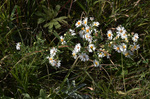
Asteraceae: Symphyotrichum ericoides
Files
Family Name
Asteraceae
Common Name
Heath aster, white heath aster
Native American Name
Lakota: čhaŋȟlóǧaŋ pȟépȟela
Description
Symphyotrichum ericoides is a perennial, herbaceous plant with a fibrous root system and slender, creeping rhizomes, forming dense, spreading colonies. Mature plants typically reach 30–80 cm in height. Stems are erect, slender, often much branched, and covered with short, fine hairs. Leaves are alternate, simple, narrow, and linear to lanceolate, 1–4 cm long and 1–3 mm wide, with entire margins and a pointed tip. Leaf surfaces are medium green and slightly rough or hairy, especially on the lower surface, and the leaf blades are sessile. Flowering occurs from August to October, with inflorescences forming dense, branched, leafy panicles up to 30 cm long and wide, with many small daisy-like flower heads. Each head is surrounded by a cylindric involucre, 3–5 mm long, with several rows of overlapping, green, lanceolate phyllaries with translucent margins. Each head contains 12–20 narrow, white ray florets, each 3–5 mm long and 0.5–1 mm wide, and 5–10 yellow disc florets. Stamens are five per disc floret, with yellow anthers about 1 mm long, forming a tube around the style. The pistil consists of a single compound ovary per floret, with a slender style about 2 mm long and a bifid (two-parted) stigma. The fruit is a small, dry, ribbed cypsela (achene), 2–2.5 mm long, grayish brown, maturing in fall; each is topped with a white, hair-like pappus 3–5 mm long for wind dispersal. Heath aster is native to South Dakota and occurs throughout the state in prairies, open woodlands, roadsides, and disturbed areas, especially in dry, sandy, or gravelly soils in full sun.
Synonyms: Aster ericoides, Aster falcatus
Horticulture Notes
Seed collection: Collect seeds from heads in late fall when achenes are dry and readily detach.
Germination: Seeds require light for germination; sow on the soil surface. No stratification is usually needed, but a brief cold period (30 days) may improve results.
Vegetative propagation: Easily propagated by division of rhizomes or basal clumps in spring or fall.
Soils: Prefers well-drained, sandy, gravelly, or loamy soils; tolerates dry, poor soils.
Light: Requires full sun for best flowering and growth.
Water: Highly drought-tolerant once established; prefers dry to moderately moist soils and does not tolerate prolonged wet conditions.
Additional Notes
Heath aster is valued horticulturally for its abundant, small white flowers that provide late-season color and support pollinators, especially bees and butterflies, when other plants have finished blooming. Ecologically, it is an important nectar and pollen source in prairie and meadow habitats, and its dense growth helps stabilize soils and provide cover for small wildlife. It is often included in wildflower mixes for habitat restoration and ornamental landscaping.