

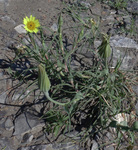
Asteraceae: Tragopogon dubius
Files
Family Name
Asteraceae
Common Name
Yellow salsify, western salsify, goat’s beard
Native American Name
Lakota: waȟčá zí iyéčheča
Description
Tragopogon dubius is a biennial (sometimes annual), herbaceous plant with a taproot. The plant typically grows 30–90 cm tall, occasionally reaching up to 120 cm. Stems are erect, simple or occasionally branched in the upper portion, hollow, glabrous, and light green to bluish green, often exuding a milky latex when cut. Leaves are alternate, simple, and linear-lanceolate with a grass-like appearance, sessile, clasping at the stem base. Each leaf is 10–30 cm long and 2–10 mm wide, gradually tapering to a long, thread-like point. Both upper and lower surfaces are smooth and glaucous (bluish green), without hairs. Flowering occurs from May to July. The inflorescence is a solitary, terminal flower head (capitulum) on a long, leafless peduncle. Flower heads are 4–6 cm in diameter when open. The involucre consists of 8–13 linear-lanceolate bracts, each 30–45 mm long, green, and extending well beyond the ray florets, giving the bud a beaked appearance before opening. The head is comprised of 20–40 yellow ray florets, each 25–35 mm long and 2–3 mm wide, strap-shaped with five small teeth at the tip. The petals are fused at the base and are a bright yellow, sometimes tinged faintly purple underneath. There are five stamens per floret, with yellow anthers fused into a tube around the style; filaments are short and pale. The pistil consists of a single style, about 15–20 mm long, which splits at the tip into two slender, recurved stigmatic branches that protrude beyond the anthers. . The pappus consists of numerous, soft, white to light brown bristles, each 20–30 mm long, aiding wind dispersal of the seeds. Fruit is a cylindrical achene, 20–35 mm long, with a conspicuous, elongated beak and ribbed surface, topped with the persistent pappus of feathery bristles. Fruits mature from June to August and turn brown when ripe. Yellow salsify is not native to South Dakota; it is native to southern and central Europe and western Asia. It is widely introduced throughout North America, including South Dakota, where it is found in disturbed sites, roadsides, pastures, prairies, and open grasslands, particularly in well-drained soils.
Additional Notes
Yellow salsify is sometimes used in wildflower mixes for its distinctive appearance and drought tolerance, though it is often considered a weed. Ecologically, it provides pollen for bees and other pollinators, and its seeds are occasionally eaten by birds. The roots are edible when young and have been consumed as a vegetable in Europe (sometimes referred to as “vegetable oyster” for their flavor), and the young shoots and flower buds are also edible raw or cooked.