

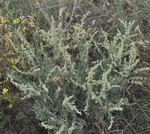
Chenopodiaceae: Atriplex gardneri
Files
Family Name
Chenopodiaceae (Amaranthaceae)
Common Name
Gardner's saltbush
Description
Atriplex gardneri is a long-lived, evergreen perennial that takes the form of a low-growing, spreading subshrub. It develops an extensive, highly branched taproot system and reproduces by developing adventitious roots where branches contact the soil. The mature plant reaches a height of 20 to 50 cm. Its stems are prostrate to ascending, featuring a woody base with light gray, smooth to somewhat shreddy trunk bark, while the upper branches remain flexible and herbaceous. Leaf insertion is mostly alternate (though lower leaves can occasionally be opposite), consisting of simple, entire leaves with a distinctive gray-green color caused by a scurfy, mealy coating. Leaves measure up to 5 cm long and 1 cm wide, featuring identical scurfy scales on both the upper and lower surfaces, and are borne on short petioles or are entirely sessile. The species is typically dioecious, with flowering occurring from mid-May to early July (occasionally extending into late summer after heavy rains). Flowers are inconspicuous and clustered in dense, terminal spike-like panicles or spikes up to 25 cm long. The flowers are highly simplified with true petals and sepals absent. Staminate (male) flowers possess a 5-lobed, free calyx-like perianth measuring approximately 1 to 2 mm in length, which is greenish yellow to translucent with a membranous texture. Pistillate (female) flowers lack a perianth entirely and are instead subtended and enclosed by two distinct fruiting bracteoles (bracts) that are fused at least to the middle, forming a protective envelope around the reproductive organs. Staminate flowers contain 5 stamens that are roughly 1.5 mm long, clear to light yellow, with prominent, free filaments. The pistillate flowers contain a single pistil with a superior ovary, a very short style, and 2 long, thread-like stigmas that protrude past the bracts to catch wind-blown pollen. The fruit is an utricle measuring 2 to 5 mm, variable in shape from ovate to compressed-globose, containing a single vertical, shiny brown-to-black seed that reaches maturity between August and September. Gardner's saltbush is native to South Dakota, where it is primarily concentrated in the western half of the state, flourishing in the harsh, arid environments of the Dakota Badlands on alkaline, saline, or clay-heavy shale soils.
Horticulture Notes
Seed collection: Harvest the fruiting bracts containing seeds by hand-stripping or flailing the stems in late summer or autumn (September to November) once the utricles dry and turn a tan-brown hue.
Seed germination requirements: Seeds benefit from a cold-water soak or rubbing/scarification to wash away built-in salt inhibitors on the seed coat, followed by 30 to 60 days of cold, moist stratification at 4o C to maximize spring germination rates.
Vegetative propagation: Highly successful via layering by pinning low-slung, flexible branches to moist earth to prompt adventitious rooting, or by semi-hardwood cuttings during mid-summer.
Soils: Prefers fine-textured, poorly developed clay, silty-clay, or shale soils with a distinctly alkaline pH range of 7.8 to 8.6. It exhibits a remarkably high tolerance for saline and sodic conditions.
Light: Requires full sun and will quickly weaken or fail if placed in shaded or heavily canopy-covered environments.
Water: Extremely low water usage; it is highly drought-resistant and adapted to survive on less than 6 to 10 inches of annual precipitation. It cannot tolerate waterlogged soils or high water tables.
Additional Notes
Gardner's saltbush provides exceptional ecological value as a highly nutritious winter food source for domestic sheep, cattle, and native wildlife such as pronghorn and deer. It withstands heavy winter grazing because its evergreen leaves retain critical protein and mineral levels when other forage is dormant. Horticulturally, its extensive root system and ability to sprout from the root make it an excellent choice for soil stabilization, erosion control, and mine spoil reclamation in western mining seed mixes. Beyond environmental management, historical human records note that native communities used the ash of burned saltbush species as a baking leaven and the vitamin-rich young seeds and leaves as an occasional emergency food source.