

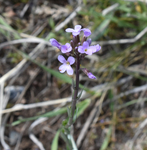
Brassicaceae: Arabis drummondii
Files
Family Name
Brassicaceae
Common Name
Drummond's Rockcress
Description
Arabis drummondii is a biennial or short-lived perennial herb that develops from a small, non-woody caudex anchoring a dominant central taproot. The plant achieves a height of 15 to 80 Cm and produces 1 to 4 erect, slender, unbranched stems that are distinctly smooth, glaucous, and glabrous, except for sparse, sessile, pick-shaped (malpighiaceous) two-rayed hairs tightly appressed near the base. It has a compact basal rosette of leaves and alternate cauline leaves. The simple leaves are deep green to grayish; the basal leaves are narrowly oblanceolate or spoon-shaped, measuring 1.5 to 8 cm long and 1.5 to 14 mm wide, with entire or sparsely toothed margins. Their upper and lower surfaces are typically glabrous or faintly pubescent, tapering to winged petioles measuring 0.5 to 3 cm long, with no ciliate simple trichomes except rarely at the petiole base. Flowering occurs from May through July, presenting an erect, terminal raceme inflorescence that bears 8 to 35 (rarely up to 80) flowers. Each flower features 4 free, glabrous, oblong sepals measuring 3 to 5 mm long and 1 to 1.5 mm wide, with a green to purplish coloration and membranous margins. The 4 free petals are organized in a cross, measuring 7 to 11 mm long and 1.5 to 2.7 mm wide, with a narrowly oblanceolate shape and a color ranging from clean white to light pink or lavender. The androecium consists of 6 stamens arranged in a tetradynamous configuration (4 long inner stamens and 2 short outer stamens), which are 3 to 5 mm long with pale yellow, ellipsoid anthers. The single superior gynoecium contains 1 pistil featuring a 2-chambered ovary roughly 4 to 6 mm long at anthesis, topped by an obsolete or short, stout style under 0.5 mm long and a small, capitate, entire stigma. The fruit is an elongated, strictly erect, straight silique measuring 4 to 10 cm long and 1.5 to 3 mm wide, which turns from green to light brown at maturity between June and August. Drummond's Rockcress is native to South Dakota, where it is localized primarily within the western portion of the state, particularly throughout the Black Hills, occurring naturally in gravelly or rocky slopes, openings in conifer forests, and open meadows.
Synonym: Boechera stricta
Horticulture Notes
Seed Collection: Harvest the slender siliques in late summer (July to August) once they turn completely dry and tan; crush the brittle pod walls carefully by hand to extract the tiny, flat, winged brown seeds.
Seed Germination: Seeds possess an innate physiological dormancy requiring a minimum of 60 days of cold, moist stratification at 34–38°F (1–3°C). Surface-sow or cover very lightly in late fall, as the seeds require ambient light exposure to trigger germination once warm temperatures return.
Vegetative Propagation: Propagate by taking herbaceous stem cuttings in early spring before flower initiation.
Soils: Rapid-draining gravelly, sandy, or coarse rocky soils; it demonstrates a high tolerance for alkaline conditions and basic, high-calcium soils (pH > 7.2).
Light: Prefers partial shade to light, filtered woodland sunlight, but can adapt to full sun conditions at higher, cooler alpine elevations.
Water: Medium-to-low moisture; it possesses excellent drought tolerance once established but has a very low tolerance for standing water, saturated soils, or poor winter drainage.
Additional Notes
Drummond's Rockcress provides subtle aesthetic value in native landscapes, where its highly structured, strictly upright fruiting stems and delicate lavender-to-white blooms create strong vertical architectural contrasts. Ecologically, the flowers serve as an early-season nectar source for native bees, flies, and specialized rockcress butterflies, while the plant itself acts as a host for various butterfly larvae. Because it easily establishes on gravelly or rocky surfaces, it provides necessary soil stabilization in fragile alpine and montane microhabitats.