

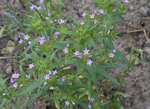
Polemoniaceae: Collomia linearis
Files
Family Name
Polemoniaceae
Common Name
Tiny trumpet, Narrow-leaf mountain trumpet
Description
Collomia linearis is an herbaceous, taprooted annual forb. The plant reaches a mature height of 10 to 60 cm. Its stems are stout, erect, usually simple or occasionally branched above, and covered with fine, velvety, white non-glandular hairs that become increasingly sticky and glandular near the apex. Leaf insertion is alternate. The simple, lanceolate to linear leaves are dark green, entire along the margins, and measure 1 to 9 cm long and 2 to 13 mm wide. Lower leaves taper gradually, while the upper stem leaves are typically broader, slightly clasping the stem, and sharply pointed at the tip. The lower surface features short, fine hairs primarily along the midvein, whereas the upper surface is largely glabrous; all leaves are sessile. Flowering occurs throughout the summer months from May through August. The inflorescence is a dense, bracted terminal head or cluster holding 7 to 20 flowers. The calyx consists of 5 fused sepals, 4 to 7 mm long, forming a pitcher-like tube connected by a translucent, papery membrane at the sinuses; the lobes are triangular, green, and turn outward but do not rupture as the underlying fruit develops. The corolla features 5 radially symmetrical, fused petals forming a slender, trumpet-like tube 8 to 15 mm long that spreads into small, rounded lobes roughly 2 mm wide. Their colors vary from pale pink or lilac to dull white. Each flower has 5 stamens attached directly to the interior corolla tube at multiple height levels, featuring short filaments under 1 mm long and enclosed anthers that shed white pollen. The single compound pistil consists of a superior, 3-chambered ovary paired with 1 elongated style that terminates in 3 distinct, tiny stigma lobes. The fruit is an oval-to-elliptic, 3-valved, explosively dehiscent capsule measuring 4 to 5 mm in diameter. It ripens to a dry, light tan-brown color between July and September, violently splitting open to project 1 brown, oblong seed per chamber. Tiny trumpet is native to South Dakota, where it is widely distributed across the state. It can be found in a variety of environments, primarily thriving in dry, open woods, sand or gravel prairies, meadows, limestone glades, and sun-exposed, disturbed corridors like roadsides and railroad banks.
Horticulture Notes
Seed Collection: Monitor the tight terminal clusters in late summer (August to September) as the capsules dry and harden into tan-brown cases. Collect them just prior to splitting, as the capsules are explosively dehiscent and will spontaneously throw their seeds.
Seed Germination: This species undergoes rapid germination without specialized stratification. Sow seeds directly on the soil surface during late autumn or early spring.
Vegetative Propagation: Tiny trumpet cannot be successfully propagated vegetatively.
Soils: Prefers poor, sandy, or gravelly soils. It easily tolerates nutrient-deficient substrates and is highly resistant to soil compaction.
Light: Best in full, open sunlight to partial shade environments.
Water: Requires moderate moisture immediately following germination. Once established, it exhibits exceptional drought tolerance. Does poorly in waterlogged, oversaturated conditions.
Additional Notes
Tiny trumpet serves as a vital component of native ecosystems by stabilizing exposed or disturbed soils and providing resources for early to mid-summer pollinators. Its tubular, pink-to-white flowers attract a diverse array of native bees, butterflies, and beeflies seeking nectar. The seeds possess a unique ecological adaptation: when moistened, the seed coat exudes a thick, sticky mucilage that forms spiraling glue-threads, anchoring the seed securely to the ground to prevent it from washing away before germination. While it lacks prominent commercial horticultural value, it functions exceptionally well in native meadow restorations and xeric rock gardens.