

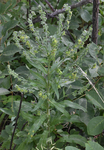
Boraginaceae: Cynoglossum officinale
Files
Family Name
Boraginaceae
Common Name
Houndstongue, Gypsy flower, Beggar's lice
Description
Cynoglossum officinale is an herbaceous, taprooted biennial (or short-lived perennial) herb with a thick, deep, woody taproot. The plant grows from 30 to 120 cm tall. Its stems are robust, erect, hollow, highly branched in the upper canopy, and densely covered in soft, spreading, velvety hairs. There is a basal rosette in the first year and alternate leaves along the flowering stem in the second year. The simple, entire, lanceolate to oblong-lanceolate leaves are dull grey green to dark green, releasing a distinct "wet dog" odor when crushed. Basal leaves measure 10 to 30 cm long and 2 to 5 cm wide, with soft, velvety, pubescent hairs on both upper and lower surfaces and a prominent midvein. Basal leaves are supported by long petioles reaching up to 15 cm, whereas the upper stem leaves gradually become smaller, completely sessile, and clasping. Flowering occurs from May through August. The inflorescence consists of numerous terminal and axillary scorpioid cymes (coiled, one-sided clusters) that elongate into a paniculate arrangement measuring 10 to 20 cm long. The calyx features 5 fused-at-the-base sepals that are deeply divided into ovate-oblong, blunt, green-to-purplish lobes, 5 to 8 mm long and 2 to 4 mm wide. They are densely pubescent and grow larger as the fruit develops. The corolla features 5 radially symmetrical, fused petals forming a short tube that opens into rounded lobes, 6 to 10 mm wide; they have a dull reddish-purple to maroon color and are equipped with 5 small scales guarding the throat of the tube. Each flower has 5 epipetalous stamens with very short filaments and oblong, yellow-to-purple anthers completely enclosed within the corolla tube. The single compound pistil features a deeply 4-lobed superior ovary with 1 short, undivided style arising from the center and terminating in a tiny, capitate stigma. The fruit consists of 4 distinct, flat-topped, egg-shaped, dry nutlets (schizocarps) measuring 5 to 8 mm long. They turn a dry, grayish-brown or tan color upon reaching maturity between July and October. Their outer surfaces are completely covered in short, stiff, barbed prickles. Houndstongue is not native to South Dakota; it is an invasive weed indigenous to Europe and temperate Asia. It is heavily naturalized across South Dakota, with particularly severe infestations clustered in the Black Hills, rangelands, pastures, forest clearings, roadsides, and disturbed fields.
Additional Notes
Houndstongue holds very little positive horticultural or ecological value in North America and is legally classified as a noxious weed across South Dakota due to its destructive impacts. It degrades rangelands by outcompeting native forage and produces toxic pyrrolizidine alkaloids that can cause irreversible liver damage or death in cattle, horses, and sheep if accidentally consumed. The barbed nutlets easily latch onto wildlife fur and livestock wool, reducing the economic value of fleece, causing severe skin or eye irritation, and disrupting animal movement.