

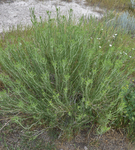
Asteraceae: Ericameria parryi
Files
Family Name
Asteraceae
Common Name
Parry's rabbitbrush, Parry's goldenbush
Description
Ericameria parryi is a perennial, small to medium-sized woody shrub that grows from a deep, woody taproot system. The plant reaches a typical height of 10 to 100 centimeters. Its flexible, ascending-to-erect stems emerge greenish when young before turning tan or gray, often displaying fastigiate branching and a dense coating of white-to-grayish matted felt hairs. The leaves are alternately arranged, simple, linear to spatula-shaped, and entire along the margins. They vary from hairless to densely woolly, appear green to grayish-green, measure 10 to 80 mm long by 0.5 to 14 mm wide, and are sessile or lack a distinct petiole. Flowering occurs from July to September. The inflorescence forms a compact, terminal cyme-, raceme-, or spike-like cluster containing multiple flower heads. Each head features a widely cylindrical involucre measuring 10 to 18 millimeters long by 4 to 8 millimeters wide, built from slightly keeled, green-tipped bracts layered in 3 to 6 series. The pappus consists of a single series of minutely barbed, tan bristles that measure slightly shorter than the corolla. Five to 20 yellow disc flowers hace 5 fused petals forming a corolla tube 8 to 12.5 mm long; ray flowers are completely absent. Each floret holds 5 stamens featuring narrow, triangular anther tips with a distinct yellow-to-tan tint. The single inferior ovary contains a solitary pistil with a long, slender style and lanceolate-to-awl-shaped stigma appendages that extend past the corolla. The fruit is a small, hairy cypsela (achene) measuring 4 to 7 mm long, ripening to a tan or brown color between October and November. Parry's rabbitbrush is native to South Dakota, where it is primarily distributed along the western edge of the state, particularly within the mountainous, rocky, and semi-arid terrain of the Black Hills and the surrounding high plains. It is typically found inhabiting open, dry pine forests, mixed-grass prairies, exposed hillsides, and eroded badlands slopes characterized by minimalist, minimally developed soil layers.
Synonym: Chrysothamnus parryi
Horticulture Notes
Seed Collection: Gather the fluffy, tan seed clusters by hand from October to November once the flower heads completely dry out.
Seed Germination: Surface-sow seeds in early spring, lightly covering them with no more than 1 millimeter of soil, and maintain warm temperatures above 68°F (20°C) with consistent moisture until germination occurs within 1 to 2 weeks.
Vegetative Propagation: Propagate via semi-hardwood stem cuttings or layering techniques treated with rooting hormone during late autumn or winter.
Soils: Prefers well-drained, porous, gravelly, sandy, or rocky alkaline soils.
Light: Requires full sunlight for optimal growth and dense branching.
Water: Extremely low water requirements once established, exhibiting superior drought tolerance but requiring regular moisture during the first spring to ensure successful root establishment.
Additional Notes
Parry's rabbitbrush provides exceptional structural value to low-water xeriscape gardens due to its high drought tolerance and attractive late-summer yellow floral displays. Ecologically, the shrub serves as a vital resource in arid ecosystems by stabilizing gravelly soils and providing cover for small wildlife. Its late-season flowers offer critical nectar to native bees, butterflies, and migrating pollinators when other forage is scarce.