

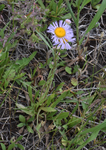
Asteraceae: Erigeron glabellus
Files
Family Name
Asteraceae
Common Name
Smooth fleabane, streamside fleabane
Description
Erigeron glabellus is a biennial or short-lived perennial herb arising from a simple caudex supported by a shallow, fibrous root system that occasionally develops short, weak rhizomes. The plant reaches a height of 15 to 70 cm, developing 1 to 8 erect or ascending stems that range from nearly glabrous with appressed hairs to densely hirsute with spreading hairs. Leaves are alternate along the stem; the basal leaves are simple, green, oblanceolate to spatulate, measuring 5 to 15 cm long and 4 to 20 mm wide, narrowing into a distinct winged petiole up to 8 centimeters long. The upper cauline leaves transition to sessile (lacking a petiole) and become progressively smaller, lanceolate to linear, with mostly smooth to sparsely appressed-hairy upper and lower surfaces. Flowering occurs from June through August, producing 1 to 15 showy, daisy-like heads arranged in loose, terminal corymb-like arrays or solitary on long stalks. It has a hemispheric involucre measuring 5 to 9 mm long and 10 to 20 mm wide, composed of 2 to 3 series of linear, green, often dark-tipped, hirsute bracts. The florets have a persistent, double-series pappus, where the outer series consists of short, inconspicuous scales and the inner series features 20 to 30 fragile, bristly, tawny hairs measuring 5 to 7 mm long. There are 125 to 175 dense, narrow, pistillate ray florets measuring 8 to 15 mm long, spreading flat in hues of lavender, pink, or white. At the center sit numerous yellow, bisexual, 5-lobed disc flowers measuring 4 to 5 mm long, within which lie 5 fused stamens bearing yellowish anthers, closely surrounding a single pistil with a deeply bifid style and elongated stigma branches. The resulting fruit is a flattened, oblong, tan to light brown, 2-nerved cypsela (achene) measuring 1.5 to 2.5 mm long, which reaches full maturity from late August through October. Smooth fleabane is native to South Dakota, where it is primarily distributed across the western counties, most notably within the Black Hills and Badland regions, inhabiting moist to dry grasslands, meadows, open woodlands, stream sides, and gravelly hillsides.
Horticulture Notes
Seed Collection: Strip the white or tan puffball seed heads by hand into paper bags during August and September.
Seed Germination: Fresh seeds require no specialized pretreatment to germinate readily, though a brief 14-day cold-moist stratification can enhance uniform spring emergence.
Vegetative Propagation: Divide mature multi-stemmed root clumps in early spring just as new basal growth begins to emerge.
Soils: Best in rich, organic, well-drained sandy or loamy soils, though it adapts well to gravelly or alkaline substrates.
Light: Prefers full sun exposure but tolerates partial shade conditions well.
Water: Possesses high drought tolerance once established, prefers medium, regular moisture and will not withstand waterlogged soils.
Additional Notes
Smooth fleabane is valued in native plant horticulture for its large, vibrant, daisy-like blossoms that offer reliable color to rain gardens and wildflower meadows from early to mid-summer. Ecologically, it supports conservation biological control by serving as an indispensable food reservoir; its long blooming period attracts a diverse assembly of native pollinators, particularly bumblebees (Bombus species) and butterflies. Historically, various Indigenous groups formulated medicinal decoctions from the roots and leaves of Erigeron species to serve as an insect repellent (giving rise to its common name "fleabane").