

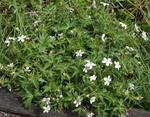
Geraniaceae: Geranium richardsonii
Files
Family Name
Geraniaceae
Common Name
Richardson's geranium, white crane's-bill
Description
Geranium richardsonii is a perennial herbaceous forb that grows from a stout, woody taproot and develops a branched, rhizomatous caudex over time. The plant typically reaches a height of 30 to 90 cm, having erect or ascending stems that are glabrous to sparsely hairy near the base but become heavily clad in sticky, glandular-tipped hairs throughout the upper canopy. Leaf insertion along the stem is opposite, though the plant also maintains a robust mound of basal leaves on elongated petioles measuring 5 to 30 cm in length. The leaves are simple, light to deep green, measuring 3 to 15 cm in width, and are deeply palmately cleft 75% to 85% of the way to the base into 3 to 7 primary, sharply toothed, rhombic lobes. Both the upper and lower leaf surfaces are covered in soft, fine puberulent hairs; pairs of lanceolate, slender stipules are present flanking the leaf bases at the nodes. Flowering occurs from June to August in loose, terminal, few-flowered cymes or two-flowered pseudo-umbels. Each flower contains 5 free, green, overlapping sepals that are 6 to 11 mm long, densely glandular-pubescent, and terminate in a distinct, stiff awn-tip 1 to 3 mm long. The corolla is composed of 5 free, distinctively spreading, white to pale lavender-pink petals that are 10 to 18 mm long, and are roughly 1.5 to 1.8 times longer than they are wide. The petals have rounded or slightly notched apexes and prominent purple or pink veins tracking down to a soft-hairy adaxial base. Arranged within the corolla are 10 fertile stamens measuring roughly 6 to 8 mm long, which possess cream-colored filaments and contrasting purple to blue-tinged anthers. The single compound pistil features an elongated, superior, 5-lobed ovary connected to a central style column that separates at the tip into 5 slender, spreading, pink-to-purple stigma branches. The resulting fruit is a dry, elongated schizocarp resembling a crane's bill, measuring 20 to 28 mm long. It matures from late summer into autumn, splitting elastically from the base into 5 separate, single-seeded, glandular-puberulent mericarp bodies. Richardson's geranium is native to South Dakota, where it occurs primarily within moist forest drainages, shaded canyons, and riparian meadows of the central and northern Black Hills region.
Horticulture Notes
Seed Collection: Collect seeds in late summer or early autumn when the vertical style column turns dark brown and crisp. Wrap small mesh bags securely around the developing fruit clusters to capture the seeds before the spring-loaded capsule valves explosively catapult them away.
Seed Germination: Fresh seeds exhibit a tough coat and require physical scarification or a period of 60 to 90 days of cold, moist stratification at 2°C to 4°C to break dormancy. Surface-sow the treated seeds in a cold frame or direct-sow them outdoors in late fall for optimal spring emergence.
Vegetative Propagation: Propagate easily by dividing the mature, rhizomatous root caudex during late winter or early spring when the plant is dormant. Ensure that each severed root segment contains at least one viable growth bud.
Soils: Prefers fertile, rich, loamy or organic-rich soils with consistent moisture. It adapts well to neutral to moderately alkaline pH conditions and can tolerate medium levels of calcium carbonate.
Light: Partial shade to dappled woodland sunlight. It will tolerate full morning sun in cooler, high-altitude climates but suffers severe foliage scorch if exposed to hot, intense afternoon sun.
Water: Requires a high and consistent supply of moisture, demanding regular watering regimes to mimic its damp stream-bank habitat. It has a moderate tolerance to temporary waterlogging but possesses zero drought tolerance.
Additional Notes
Richardson's geranium is highly valued in woodland horticulture for its delicate, icy-white blossoms that provide a refreshing visual contrast in moist, semi-shaded perennial borders, rain gardens, and stream margins. Ecologically, its glandular, nectar-rich flowers serve as a primary food source for various native bees, hoverflies, and butterflies, while its dense foliage offers protection and forage for small woodland mammals. The high-protein seeds are consumed by upland game birds and songbirds alike. Humans have historically used the roots and leaves of the plant in traditional indigenous medicine, crafting decoctions high in natural tannins to serve as an astringent wash for treating minor cuts, sore throats, and gastrointestinal upset.